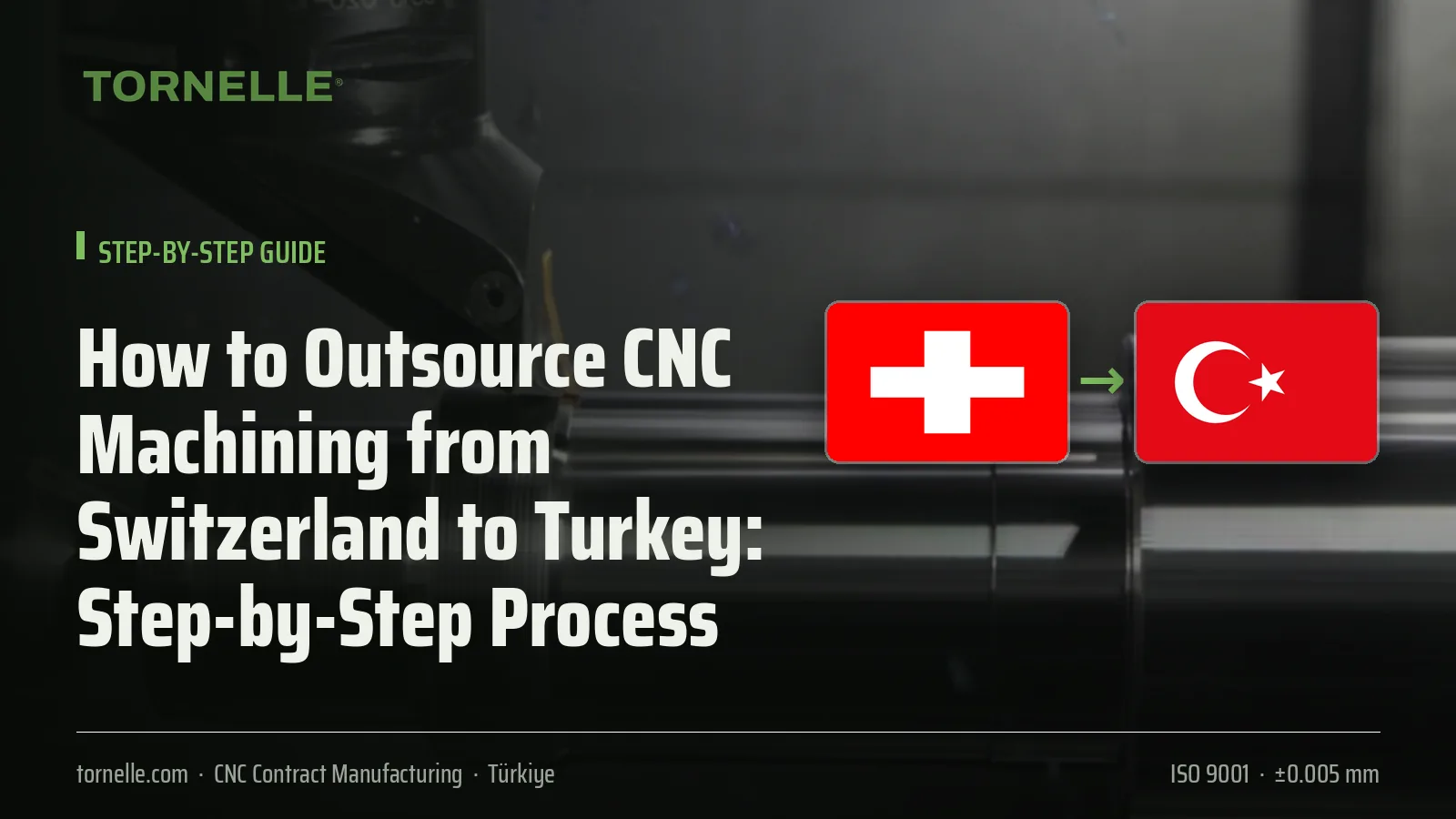
You already know the advantages Turkey offers Swiss companies: a 35–50% cost advantage against the strong franc, experience in Swiss-type turning and micron precision, duty-free trade under the EFTA agreement. This article explains step by step how to place the first order in practice; because Switzerland is not an EU member, the customs step differs from EU countries, and we explain these differences in particular.
Step 1: Prepare the Technical Documents
Swiss drawings are prepared to SN EN ISO standards and are read without difficulty in Turkey; German or French notes are usually not a problem, but an English equivalent of critical notes prevents errors. The ideal package:
- STEP (AP214/AP242) 3D model + PDF technical drawing; revision numbers must match.
- Material with its EN or DIN grade (medical stainless steels such as 1.4404, 1.4435, 1.4441; 42CrMo4; EN AW-7075; CW614N; a standard reference such as ASTM F136 for Ti Gr. 5). For medical materials, state the standard and the expected mill certificate.
- General tolerance (ISO 2768-fH or mK) and geometric tolerances with their datums; indicating which of the tight tolerances common on Swiss drawings are functional reduces the price.
- Surface roughness (Ra/Rz), edge-break, cleanliness and packaging requirements (particle and oil-free conditions for medical parts).
- Annual quantity, batch size, first-order quantity and target date.
- Documentation expectations: inspection report, EN 10204 3.1, FAI, process validation if required.
Step 2: Request and Compare Quotes
Send the RFQ to 2–3 Turkish suppliers; compare the quotes item by item: unit price (quantity tiers), set-up, certificate, inspection report, packaging, delivery term and lead time. Two points matter for Swiss buyers: you can request the quote in EUR or CHF (Turkish suppliers mostly price in EUR, a CHF reference can be added) and you should ask in the quote about the measuring method for tightly toleranced features. A supplier who sends tolerance/DFM recommendations with the quote is showing process discipline. See our RFQ guide.
Step 3: Clarify the Commercial Terms
Incoterms
FCA Istanbul (your own forwarder collects) or DAP (the Turkish supplier brings the goods to your address in Switzerland; the import declaration and VAT are yours) are the most practical options. DDP is rare and not recommended because it requires the seller to be VAT-registered in Switzerland. Details are in our Incoterms guide.
Payment
SWIFT transfer is standard; a partial advance payment (30–50%) + balance before shipment on first orders and 30 days open account in a regular relationship are common. The 30 days net customary in Switzerland is an acceptable starting point for Turkish suppliers too. If the currency is EUR the exchange risk stays on the Turkish side, if CHF it stays on yours; clarify this in the contract.
Contract and confidentiality
An English or German NDA and quality agreement are sufficient. Because know-how protection is critical in the medical and watch industries, having the NDA signed before the RFQ is common; Turkish suppliers are used to this. The governing law and place of arbitration (Zurich or Istanbul) should be specified.
Step 4: Sample and First Article Approval
On the first order, request 1–5 sample pieces and a full inspection report based on a ballooned drawing (Erstmusterprüfbericht / EMPB). For tightly toleranced features the measuring instrument and its uncertainty should appear in the report; Swiss quality teams pay attention to this. Verify the report with your own measurement; series production starts after approval. For medical parts, process validation (Cpk on critical characteristics) may be requested in addition to the FAI. The process is described in our FAI guide.
Step 5: Customs and Import: Points Specific to Switzerland
Because Switzerland is not in the EU Customs Union, A.TR is not used; the process is as follows:
- Customs duty: Switzerland unilaterally abolished customs duties on industrial products from 1 January 2024; CNC-machined metal parts enter duty-free regardless of origin. In addition, under the EFTA–Turkey Free Trade Agreement an EUR.1 or invoice declaration can be issued for products of Turkish origin; although no longer necessary for duty purposes, the origin record may be useful (for example when re-exporting your products to the EU). For the origin document see our A.TR and origin guide.
- VAT (MWST): 8.1% import VAT is charged on the customs value (goods + freight); VAT-registered companies offset it in their return. Regular importers can apply for deferred payment (Verlagerungsverfahren).
- Declaration: the forwarder or customs broker files the import declaration with your UID number via the e-dec/Passar system. Commercial invoice, packing list and transport document are sufficient.
- Logistics: road freight from Istanbul to Zurich, Basel or Geneva takes 5–7 working days door to door (Balkans–Austria route, customs at the Swiss border); air freight 1–2 days; express courier 2–3 days for small samples (the courier collects the VAT).
Step 6: Series Deliveries and Continuous Improvement
Call-off orders (Rahmenvertrag + Abrufe) and batch-based deliveries are common. An inspection report and certificates accompany every batch; for medical parts, batch traceability (lot number, heat number) is on the label. After the first 2–3 batches, price, packaging and frequency settle; a material-indexed rule should be defined for the annual price update.
Common Mistakes
- Expecting an A.TR: it does not apply to Switzerland; there is no customs duty anyway, and an EUR.1 is used if needed.
- Requesting DDP: it requires the seller to be VAT-registered in Switzerland; DAP is more practical.
- Leaving all tolerances as tight as those given to a Swiss domestic supplier; relaxing non-functional tolerances reduces the price noticeably.
- Not expecting VAT collection on samples arriving by courier.
- Not stating medical cleanliness and packaging requirements in the RFQ; requirements added later change the price.
Frequently Asked Questions
Can I send technical drawings in German or French?
Yes; dimensions and symbols are international, and German is widely understood. Adding an English equivalent of critical French notes is useful.
How much time should I plan for the first order?
Quote 1–2 days, sample 1–3 weeks, series 3–5 weeks after approval, freight 5–7 days: the first series batch is typically in your hands in 7–10 weeks.
How does the process work in case of a complaint?
Notification with photos and measurement evidence, an 8D report, re-production or credit note; defined in writing in the quality agreement. Re-supply by air freight is possible in 1–2 days.
Do I need to visit the supplier in Turkey?
Not mandatory; a same-day audit is possible with a 3-hour direct flight from Zurich and Geneva to Istanbul. For medical and defence parts a visit before the first series is common.
Conclusion
Outsourcing CNC machining from Switzerland to Turkey is a predictable process consisting of the right file package, an itemised quote, rigorous sample approval and a simple import declaration (no customs duty, 8.1% VAT). Send your technical drawings and quantity information via our quote form; you will receive an itemised EUR-based quote (with a CHF reference on request) within 24 hours. For the process steps see our how we work page.