Customs documents look boring; but the wrong document can mean paying duty at customs, a shipment waiting, or a retroactive duty assessment in a customs audit years later. An importer buying CNC parts from Turkey only needs to distinguish two documents: the A.TR and the EUR.1. This article extends our A.TR guide with the origin dimension and complements our Incoterms article on the documentation side.
A.TR: Free-Circulation Document (Not Origin)
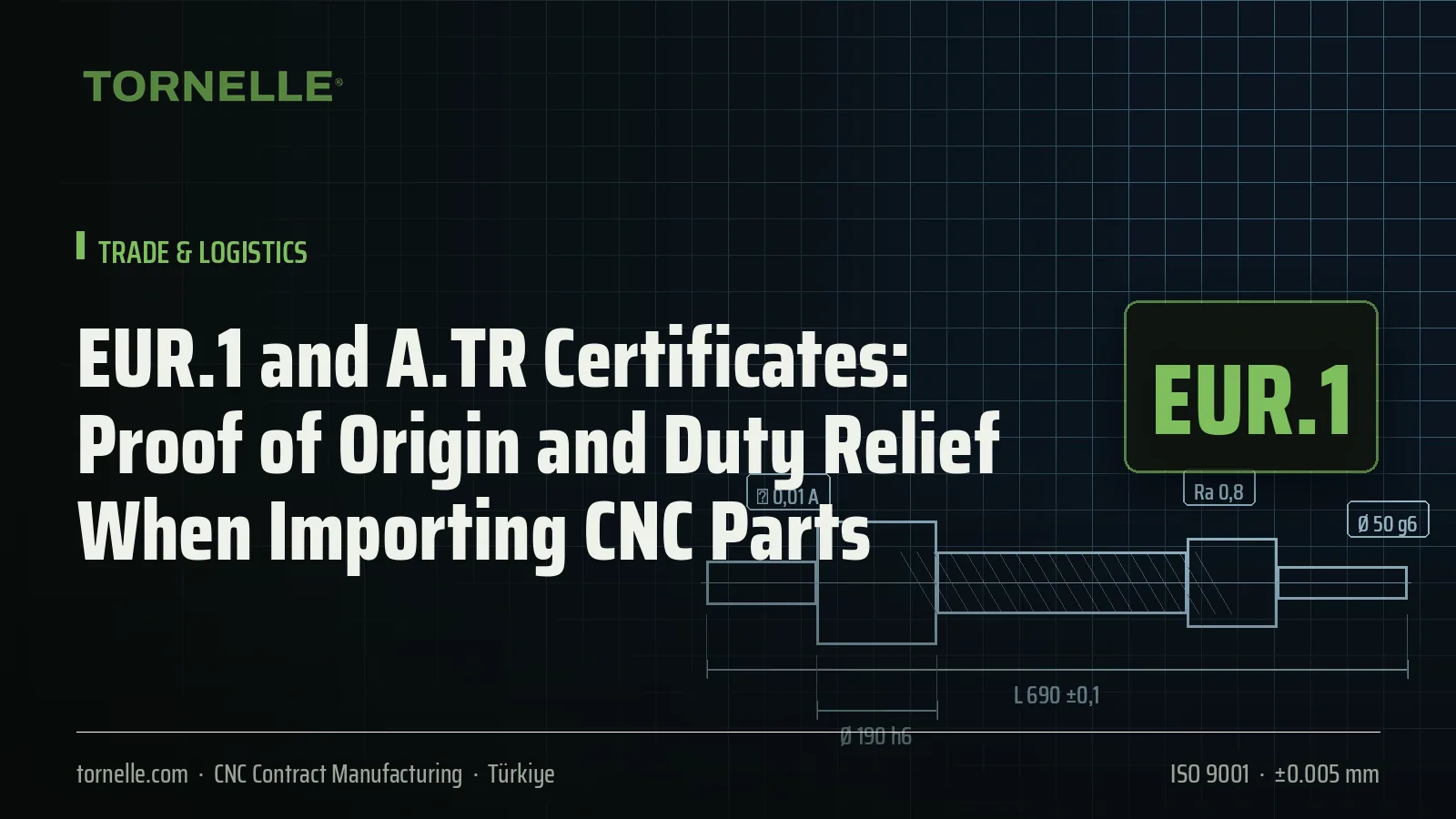
The A.TR movement certificate is specific to the Turkey–EU Customs Union and is used only for industrial goods in trade with the 27 EU members. The only thing the document says is: "These goods are in free circulation in Turkey (or the EU)." That is, the goods were either produced in Turkey or imported from a third country with duties paid. Goods with an A.TR enter the EU duty-free; no rule of origin is required.
- Who issues it: the exporter issues it through the chamber of commerce/industry (TOBB system) and the customs administration endorses it; companies with approved-exporter status issue it themselves without endorsement.
- Validity: it must be presented to the customs office of arrival within 4 months of the date of issue.
- Outside scope: agricultural products and raw steel products covered by the ECSC (coal and steel) scope (a separate agreement and EUR.1 apply to these). Machined CNC parts (HS 73, 84, 85, 87 etc.) are within the A.TR scope.
- Important limit: the A.TR does not prove origin. If the EU importer wants to use a part bought from Turkey with an A.TR in its own product and export it to a third country (UK, Switzerland, Korea etc.) with preferential origin, it must separately prove that the part is of Turkish origin (see the supplier's declaration section below).
EUR.1: Preferential Origin Document
The EUR.1 movement certificate proves that goods are of Turkish origin in trade with countries with which Turkey has a free trade agreement (FTA) and provides exemption from or reduction of that country's customs duty. Origin is about where the goods were "sufficiently worked or processed", not only where they were shipped from.
- Who issues it: the exporter issues it through the chambers and customs endorses it; the proof of origin (production records, material invoices) is retained.
- Invoice declaration / origin declaration: if the shipment value does not exceed €6,000, the exporter can write the standard origin declaration on the invoice and use it instead of the EUR.1; approved exporters use the invoice declaration without a value limit.
- EUR-MED: when inputs from more than one country within the Pan-Euro-Mediterranean cumulation system are used, a EUR-MED certificate or declaration is required.
- Validity: generally 4 months (10–12 months in some agreements).
Which Document for Which Country?
| Destination country | Document | Customs duty (CNC-machined metal part) | Note |
|---|---|---|---|
| EU (27 members) | A.TR | 0% | No origin required; VAT only |
| Switzerland, Norway, Iceland, Liechtenstein (EFTA) | EUR.1 or invoice/origin declaration | 0% (if of Turkish origin); Switzerland and Norway also apply zero unilaterally on industrial goods | Turkey–EFTA FTA |
| United Kingdom | Origin declaration (on the invoice); EUR.1 is not used | 0% (if of Turkish origin); otherwise UK Global Tariff (0–4% on most parts) | Turkey–UK FTA (2021) |
| Serbia, Bosnia and Herzegovina, North Macedonia, Montenegro, Albania, Kosovo, Moldova, Georgia | EUR.1 / EUR-MED or declaration | 0% (if of Turkish origin) | Bilateral FTAs |
| Israel, Egypt, Tunisia, Morocco, Jordan, Palestine, Lebanon | EUR.1 / EUR-MED or declaration | 0% or reduced | Mediterranean FTAs |
| South Korea, Malaysia, Singapore, Chile, Mauritius, Faroe Islands | Origin declaration or EUR.1 (depending on the agreement) | 0% or reduced | Bilateral FTAs |
| United Arab Emirates | Agreement-specific origin document | Reduced / phased down to zero (CEPA, 2023) | Product list and schedule must be checked |
| USA, Canada, Saudi Arabia, Qatar, Australia etc. | Certificate of origin (non-preferential) | The country's normal tariff | No FTA; the document only shows origin |
Agreements and product lists can change; verify the current status with your forwarder or customs broker before shipment.
How Do Rules of Origin Apply to a CNC Part?
For a part to count as "of Turkish origin" it must be wholly obtained in Turkey, or imported inputs must have undergone "sufficient working or processing" in Turkey. Most agreements follow the Pan-Euro-Mediterranean (PEM) rules of origin; typical rules for machined metal parts:
- Change of tariff heading: if imported bar or plate (HS 72/76) is machined in Turkey and moves to a different heading (HS 73, 84, 87 etc.), it usually acquires origin.
- Value-added rule: for some headings, the value of non-originating inputs must not exceed a certain percentage of the ex-works price (typically 40–50%). Care is needed with this rule for simple parts with a high material share.
- Insufficient processing: cutting, labelling, packaging or simple assembly alone does not confer origin. Machining counts as "sufficient processing".
- Cumulation: a part produced in Turkey from EU- or EFTA-origin bar easily meets the origin rule thanks to PEM cumulation.
In practice: CNC parts machined from bar in Turkey are almost always of Turkish origin; the exception is parts where only light processing is done on semi-finished goods imported from the Far East. The exporter is obliged to keep the proof of origin (material invoices, production records) for 3–5 years.
Supplier's Declaration: For EU Buyers Who Re-export
If a company in the EU wants to fit a part bought from Turkey with an A.TR into its machine and export it to the United Kingdom, Switzerland or Korea with preferential origin, the status of the Turkish part matters in the origin calculation:
- In the EU–Switzerland, EU–Norway and other agreements within PEM, Turkey is included in cumulation; a part of Turkish origin can count as an "originating input" in the origin calculation of the EU product. For this, proof of origin must be obtained from the Turkish supplier in the form of a supplier's declaration or a EUR.1/EUR-MED; an A.TR is not enough.
- In the EU–UK Trade and Cooperation Agreement (TCA), Turkey is not included in cumulation; here the Turkish part enters the calculation as a "non-originating input". If the part share is high, it can affect the origin rule of the EU product.
- In regular supply, a long-term supplier's declaration (once a year, for all shipments) is the practical solution; request it from the Turkish supplier.
Document Errors and Their Consequences
- If the A.TR is missing or presented late, EU customs applies the third-country tariff (usually 1.7–4.7% on CNC parts); a refund can be requested by presenting the document afterwards, but additional workload arises.
- If it later emerges that the origin rule was not met on a EUR.1, the importer pays retroactive duty and interest; therefore the supplier's retention of the proof of origin is also the importer's assurance.
- The invoice declaration text must match the standard wording in the agreement exactly; free text is not accepted.
- Sending an A.TR for Switzerland is a common mistake; the document is invalid (although duty on industrial goods in Switzerland is already zero).
What Should You Do as an Importer?
- Tell the Turkish supplier the destination country and, if applicable, your re-export plan; determine the document type together.
- Write into the order confirmation that the A.TR for the EU, the EUR.1 or origin declaration for EFTA, and the origin declaration on the invoice for the United Kingdom must be included in the shipping documents.
- If you re-export, request a long-term supplier's declaration.
- Tell your forwarder explicitly to use the document in the import declaration; it is not assumed automatically.
- Keep the documents for 3–10 years (depending on the country) for customs audits.
Tornelle issues the document appropriate to the destination country for its shipments and provides a long-term supplier's declaration for regular customers; for country-specific customs notes see our EU overview and Switzerland guides.
Frequently Asked Questions
What is the basic difference between A.TR and EUR.1?
The A.TR proves free circulation and is valid only for the EU; it does not show origin. The EUR.1 proves Turkish origin and is valid for FTA countries (EFTA, the Balkans, the Mediterranean etc.).
Is a EUR.1 required for the United Kingdom?
No; under the Turkey–UK FTA only the origin declaration on the invoice is used.
If I use a part bought from a Turkish supplier in my EU product and export it to Switzerland, is there an origin problem?
Thanks to PEM cumulation, a part of Turkish origin can count as an originating input; but this requires proof of origin by supplier's declaration or EUR.1, not an A.TR.
Do I pay extra for the documents?
The cost of issuing an A.TR or EUR.1 is low (chamber fee) and is usually borne by the exporter; check for the wording "documents included" in the quote.
Conclusion
Duty-free entry into the EU with the A.TR, relief in FTA countries with the EUR.1 or origin declaration, origin assurance on re-export with the supplier's declaration: the right document, the right country and the right time. If you would like to clarify at the quotation stage which document your shipping documents require, send your technical drawings via our quote form stating your destination country; you will receive an itemised quote including documents and delivery terms.