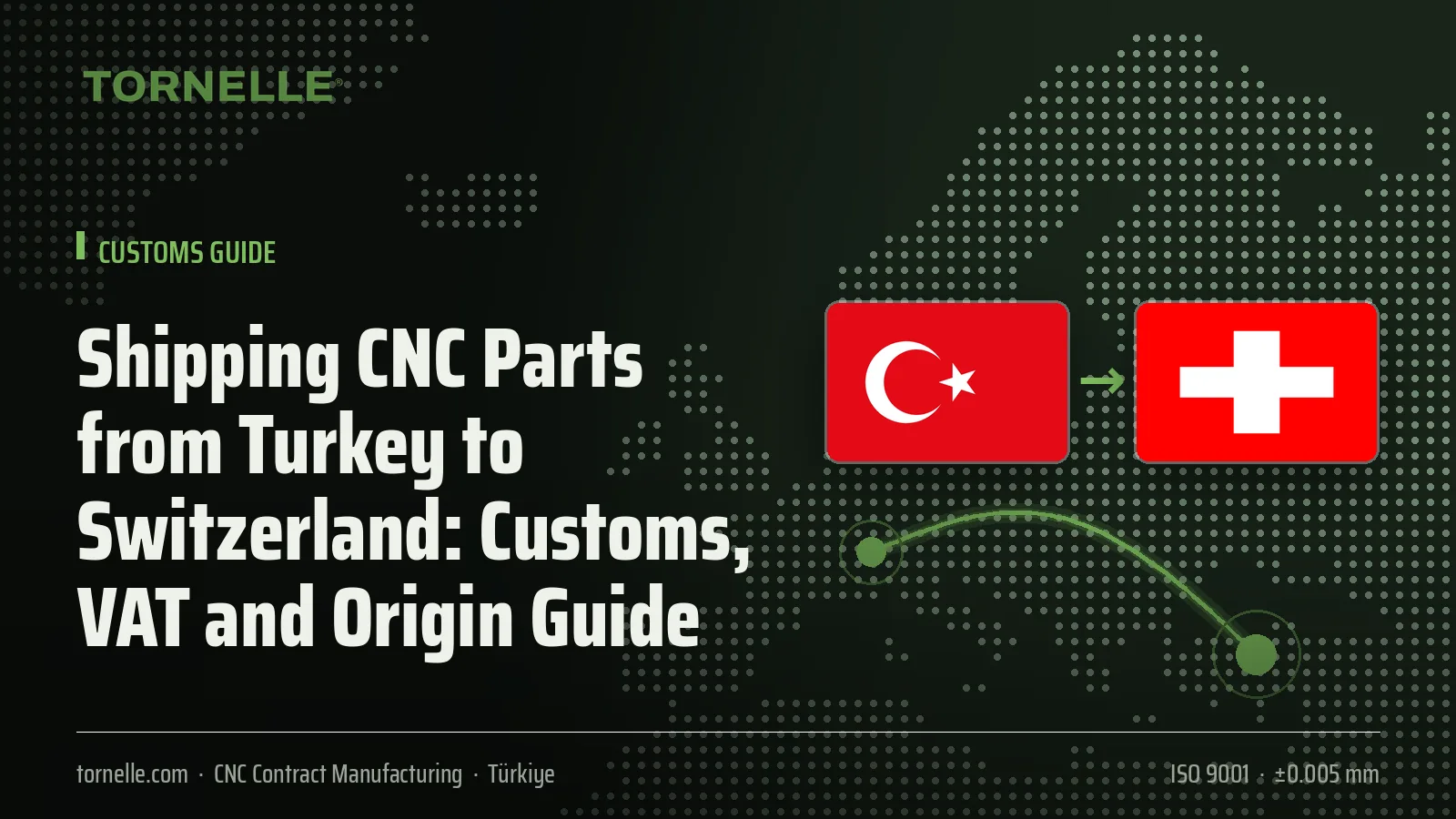
For Turkey, Switzerland is one of the most interesting precision-part markets in Europe: a high price level, a tight-tolerance culture and a strong franc. As a complement to our guide to placing work in Turkey from Switzerland, this article focuses solely on customs, VAT and origin; these are the most frequently asked questions on the Swiss route.
1. Legal Framework: The EFTA–Turkey FTA
Between EFTA, which covers Switzerland, Norway, Iceland and Liechtenstein, and Turkey there has been a free trade agreement in force since 1992, updated in 2018. Industrial goods of Turkish origin enjoy preferential treatment under this agreement. The A.TR, the document of the EU–Turkey Customs Union, is not valid on this route; instead the EUR.1 movement certificate or an origin declaration on the invoice (anyone for consignments below €6,000, approved exporters above) is used. The documents are detailed in our EUR.1 and A.TR article.
2. After 2024: Zero Customs Duty on Industrial Goods
As of 1 January 2024 Switzerland abolished customs duties on industrial goods (tariff chapters 25–97) regardless of origin. The practical consequence: for CNC parts from Turkey there is no customs duty anyway; a EUR.1 or origin declaration is no longer mandatory for import duty purposes. Proof of origin is still meaningful in two cases:
- If the part is processed in Switzerland and re-exported to the EU or another preferential country (a supplier's declaration is needed for origin cumulation).
- If the origin of inputs matters for your customer's own origin calculation (for example "Swiss made" or EU preferential origin).
Not requesting proof of origin for parts used only in Switzerland saves document cost and time. If in doubt, consult your customs broker.
3. Tariff Code and Simplified Classification
With the abolition of duties Switzerland also simplified its tariff structure for industrial goods; many sub-headings were merged. The import declaration still requires the 8-digit Swiss tariff number (Tares): general steel parts 7326, aluminium 7616, brass 7419, machine parts in the relevant chapter (8409, 8481, 8483 etc.). Have the code printed on the commercial invoice.
4. Import VAT (MWST / TVA)
The standard rate of Swiss import VAT is 8.1% (from 2024). It is assessed at customs; VAT-registered Swiss companies deduct it as input tax in their VAT return. To avoid the cash outflow you can apply to the FTA (ESTV) for the Verlagerungsverfahren (deferred payment procedure); importers meeting the conditions do not pay VAT at customs but account for it in the return. Recommended for companies importing regularly. Otherwise payment is made through the forwarder's customs account (ZAZ).
5. Declaration System: e-dec and Passar
Swiss customs declarations are moving from the e-dec system to the new Passar platform; the forwarder or customs broker files the declaration electronically. As importer, your UID number (Swiss business identification number) is used in the declaration. Required documents: commercial invoice (tariff code, Incoterm, UID, gross/net weight), packing list, CMR/AWB, and if required proof of origin and material certificate. Clearance takes place at the border or at an inland customs office (Zurich, Basel).
6. Choosing the Incoterm
- FCA Istanbul: Your forwarder collects; transparent and economical at regular volumes.
- DAP (Swiss address): The Turkish supplier delivers to your door; import declaration and VAT are yours. Practical for first orders.
- DDP: Rare among Turkish suppliers because it requires VAT registration in Switzerland.
Details in our Incoterms guide.
7. Logistics and Lead Times
| Method | Time | Note |
|---|---|---|
| Road (via Austria or Germany) | 4–6 working days | Weekly groupage departures; the night/Sunday truck ban in Switzerland may affect timing |
| Express courier | 2–3 days | Samples; customs handled by the courier |
| Air freight (Istanbul–Zurich) | 1–2 days + customs | Urgent series parts |
By road, loads are usually consolidated in Germany and enter via Basel or St. Margrethen. General European logistics is covered in our logistics article.
8. Switzerland-Specific Points
- Currency: Turkish suppliers quote in euros; if payment in CHF is required, the exchange-rate mechanism should be fixed at quotation stage.
- Packaging wood: ISPM 15-marked pallets are required.
- Document accuracy: Swiss customs is strict about weight/quantity differences between invoice and packing list; documents must match exactly.
- Inspection report expectation: Swiss buyers expect a full dimensional report; the CMM report is sent with the shipment.
Example: A Medical Device Manufacturer in Zurich
A company in the Zurich area producing laboratory instruments started buying 3,500 stainless (1.4404) and aluminium (6082) turned-and-milled parts a year from Turkey. Commercial set-up: DAP Zurich, euro-based prices, 30-day terms. Document package: commercial invoice (Tares tariff code, UID number), packing list, CMR, a CMM inspection report and EN 10204 3.1 certificate with every batch. Because the parts are only assembled in Switzerland and the finished device is assessed on a value basis in the Swiss made calculation, no proof of origin was requested; this reduced document cost and time. Import VAT was accounted for and deducted in the return under the Verlagerungsverfahren; nothing was paid at customs. Road transit averaged 5 working days; in urgent cases Istanbul–Zurich air freight delivered in 2 days. In the first year total part cost fell by 48% compared with the previous Swiss supplier; the most important lesson was that an invoice and packing list matching exactly reduced delays at Swiss customs to zero.
Short checklist for the Swiss buyer
- Give your UID number and tariff code to the supplier in advance.
- Do you really need proof of origin? If there is no re-export, do not request it.
- Apply for the Verlagerungsverfahren before the first shipment.
- Write ISPM 15 pallets and a consistent document set into the contract.
Frequently Asked Questions
Is there customs duty on importing CNC parts from Turkey into Switzerland?
No; since 1 January 2024 Switzerland has abolished customs duties on industrial goods. Only import VAT (8.1%) applies.
Is the EUR.1 certificate still required?
Not for import duty. Request it if you will re-export the part or need it for your origin calculation.
Is the A.TR document valid in Switzerland?
No; the A.TR is valid only within the EU–Turkey Customs Union. For Switzerland the EUR.1 or an origin declaration is used.
Do I have to pay VAT at customs?
Not if you are registered for the deferred payment procedure (Verlagerungsverfahren); otherwise it is paid through the forwarder's customs account and deducted in the return.
How does customs work if I send samples or tooling from Switzerland to Turkey?
They can be sent under temporary export (ATA carnet or returned-goods procedure); for permanent shipment an import procedure in Turkey is required. The Turkish supplier manages this with its forwarder; add the time to your planning.
Do Turkish suppliers know Swiss standards?
Drawings are ISO-based and read without difficulty; if there are VSM (Swiss machinery standard) references, stating the ISO equivalent is sufficient.
Conclusion
Importing parts from Turkey into Switzerland is, after 2024, one of the simplest processes in Europe: no customs duty, a light document load, 4–6 days by road. Send your drawings via our quote form; we quote in euros with DAP Switzerland delivery and a full inspection report.