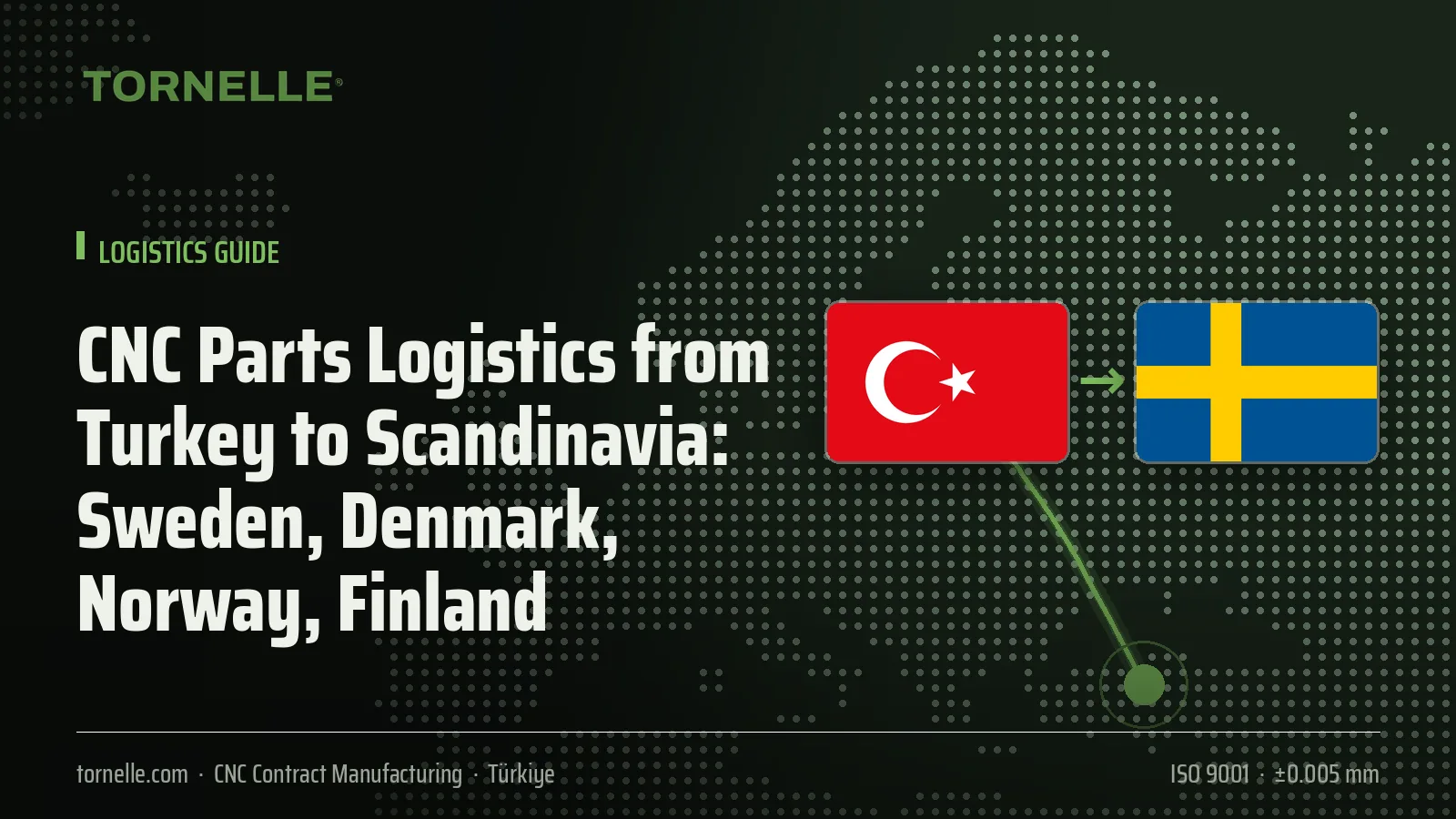
Sweden's machinery and automotive industry, Denmark's pump and wind sector, Norway's marine and energy equipment, Finland's forestry machinery and heavy industry create strong demand for CNC parts sourced from Turkey. As the logistics complement to our Sweden, Denmark and Norway advantage articles, this article explains how the distance is managed. For the general framework see our European logistics article.
Distance and Transit Time Table
| Destination | Road distance | Full truck load (FTL) | Groupage (LTL) | Air freight (door to door) |
|---|---|---|---|---|
| Copenhagen / Aarhus (DK) | 2,700–2,900 km | 4–5 days | 6–8 days | 2–3 days |
| Malmö / Gothenburg (SE) | 2,900–3,100 km | 5–6 days | 7–9 days | 2–3 days |
| Stockholm (SE) | 3,300–3,500 km | 6–7 days | 8–10 days | 2–3 days |
| Oslo (NO) | 3,200–3,400 km | 6–7 days + customs | 8–11 days | 3–4 days (incl. customs) |
| Helsinki / Tampere (FI) | 3,400–3,700 km (incl. ferry) | 7–8 days | 9–12 days | 2–4 days |
Times are given in working days from loading day to delivery day; they vary with season, customs and ferry schedules.
Road Routes
- Western route: Istanbul – Kapıkule – Bulgaria – Serbia – Hungary – Austria/Slovakia – Czech Republic – Germany – Denmark (Flensburg border) – Storebælt bridge – Öresund bridge – Sweden. The standard European route as far as Germany, then bridge crossings; the most common way for Denmark and southern Sweden.
- Ferry route: Ferry from German (Rostock, Travemünde, Kiel) or Polish (Gdynia, Świnoujście) ports to Sweden (Trelleborg, Malmö, Karlskrona) or Finland (Helsinki); preferred for central and northern Sweden and Finland, the driver spends the rest period on the ferry.
- Norway: Via Sweden (Svinesund border) or by ferry from Denmark (Hirtshals–Larvik/Kristiansand). Since Norway is not an EU member, customs clearance takes place at the border.
- Finland: Poland – Baltic states (Lithuania, Latvia, Estonia) – Tallinn–Helsinki ferry as the land-heavy alternative; or direct Ro-Ro ferry Germany/Poland–Helsinki.
Groupage: Consolidation Hubs
Finding a weekly direct groupage truck to Scandinavia from Istanbul is difficult; forwarders usually consolidate at a warehouse in Germany (Hamburg, Bremen) or Poland and transfer to the Scandinavian distribution network. This means 1–3 days extra but reasonable cost. Typical groupage rate per pallet: Denmark €180–260, southern Sweden €200–300, Stockholm €250–350, Oslo €280–400 (excluding customs), Finland €280–420. For small batches (1–3 pallets) groupage; for 8+ pallets a full truck or sea container is economical.
Sea Freight
For heavy and large batches there are container services from Istanbul (Ambarlı) or Izmir to Gothenburg, Aarhus, Helsinki and Oslo; 18–28 days with transhipment at northern European ports (Hamburg, Rotterdam). A 20' container is in the €1,400–2,400 range. Ro-Ro: the Turkey–Trieste line shortens the route to Germany, then road. Sea freight makes sense for regular monthly shipments and buyers with a stock buffer.
Air Freight
There is daily passenger aircraft cargo capacity from Istanbul to Copenhagen, Stockholm, Oslo and Helsinki; 2–3 days door to door. Cost €3.5–6/kg (consolidated above 100 kg); below 50 kg courier (DHL/UPS/FedEx Express) is 3–4 days and more practical. For samples, urgent parts and series with a high value-to-weight ratio (Swiss-type parts), air freight is particularly sensible for Scandinavia because the road transit is long.
Customs: EU Members and Norway
Sweden, Denmark and Finland are EU members: with the A.TR, customs duty is 0% and import VAT (SE 25%, DK 25%, FI 25.5%) is reclaimed in the return. Norway is outside the EU but a member of EFTA; the Turkey–EFTA Free Trade Agreement provides preferential tariffs on industrial products; for this, not the A.TR but a EUR.1 movement certificate or an invoice declaration (proof of origin) is required. In Norway most industrial products are duty-free anyway; import VAT of 25% is assessed and the VAT-registered company reclaims it. Norwegian customs takes 0.5–1 day at the border or at the arrival depot; the forwarder must have a Norwegian customs broker. Norway's "TVINN" system accepts electronic declarations.
Winter Conditions and Packaging
In the November–March period, snow and ice on Scandinavian roads, ferry cancellations and bridge closures (storms) can extend transit by 1–3 days. Leave a winter buffer in planning. Temperature difference matters in packaging: steel parts moving from a warm warehouse to a cold truck carry condensation and rust risk; corrosion protection with VCI paper or VCI bags, desiccant packs and closed packaging should be used. In aluminium and stainless the risk is low but separator paper is needed for surface quality. Details are in our packaging article.
Strategies for Shortening Delivery Time
- Mixed model: First batch by air freight, remaining series by road/sea; the line does not stop.
- Consignment or call-off stock: 4–8 weeks of stock at a forwarder warehouse in Germany or Denmark; the buyer draws in 1–2 days.
- Fixed shipping schedule: Consolidated truck in a set week of each month; the forwarder reserves capacity.
- Northern European hub: Hamburg consolidation for several Scandinavian customers; cost falls.
- Electronic pre-dispatch of documents: Invoice, packing list, A.TR/EUR.1 copy to the forwarder in advance; waiting at customs is eliminated.
Cost Example
For a buyer in Gothenburg, 6 pallets, 2,400 kg of stainless turned parts: groupage by road ~€1,500, full truck (shared) ~€2,200, sea container (with transhipment) ~€1,600 + port charges, air freight ~€10,000. If the part value is €60,000, the road cost is 2.5% of the value; Turkey's price advantage (25–35%) more than covers this cost. The same shipment to Norway adds €300–500 in customs and broker fees.
Forwarder Selection
Choose a forwarder experienced on the Scandinavian route, with its own consolidation warehouse in Germany or Poland and a local broker partner for Norwegian customs; there are several Turkish and international forwarders in Istanbul fitting this profile. Ask for the following in the quote: route, consolidation point, weekly departure day, winter buffer, tracking system and customs document list. If the buyer has its own forwarder, its network can also be used with FCA Istanbul delivery; the Turkish collection network of Scandinavian forwarders generally works through their German partners.
Frequently Asked Questions
How many days by road from Turkey to Sweden?
Full truck 5–6 working days to southern Sweden, 6–7 to Stockholm; groupage 7–10 days. Add 1–3 days in winter.
Is the A.TR valid for Norway?
No; Norway is not an EU member. Under the Turkey–EFTA agreement a EUR.1 or invoice declaration is used; it provides preferential tariffs on industrial products.
What is the most practical route to Finland?
Road with the Helsinki ferry from a German or Polish port; for small and urgent batches air freight 2–4 days.
Do parts rust in winter?
Temperature difference creates condensation; the risk is controlled with VCI protection and closed packaging. For steel parts this should be written as a requirement.
Conclusion
Scandinavia is 5–8 days by road from Turkey; when the right route, consolidation, EUR.1 for Norway and winter packaging are planned, logistics does not overshadow Turkey's price and capacity advantage. Request a CNC parts quote for your Scandinavian facility via our quote form with the delivery place (DAP) and shipping frequency; we also provide a route and transit time proposal with our forwarder partners.