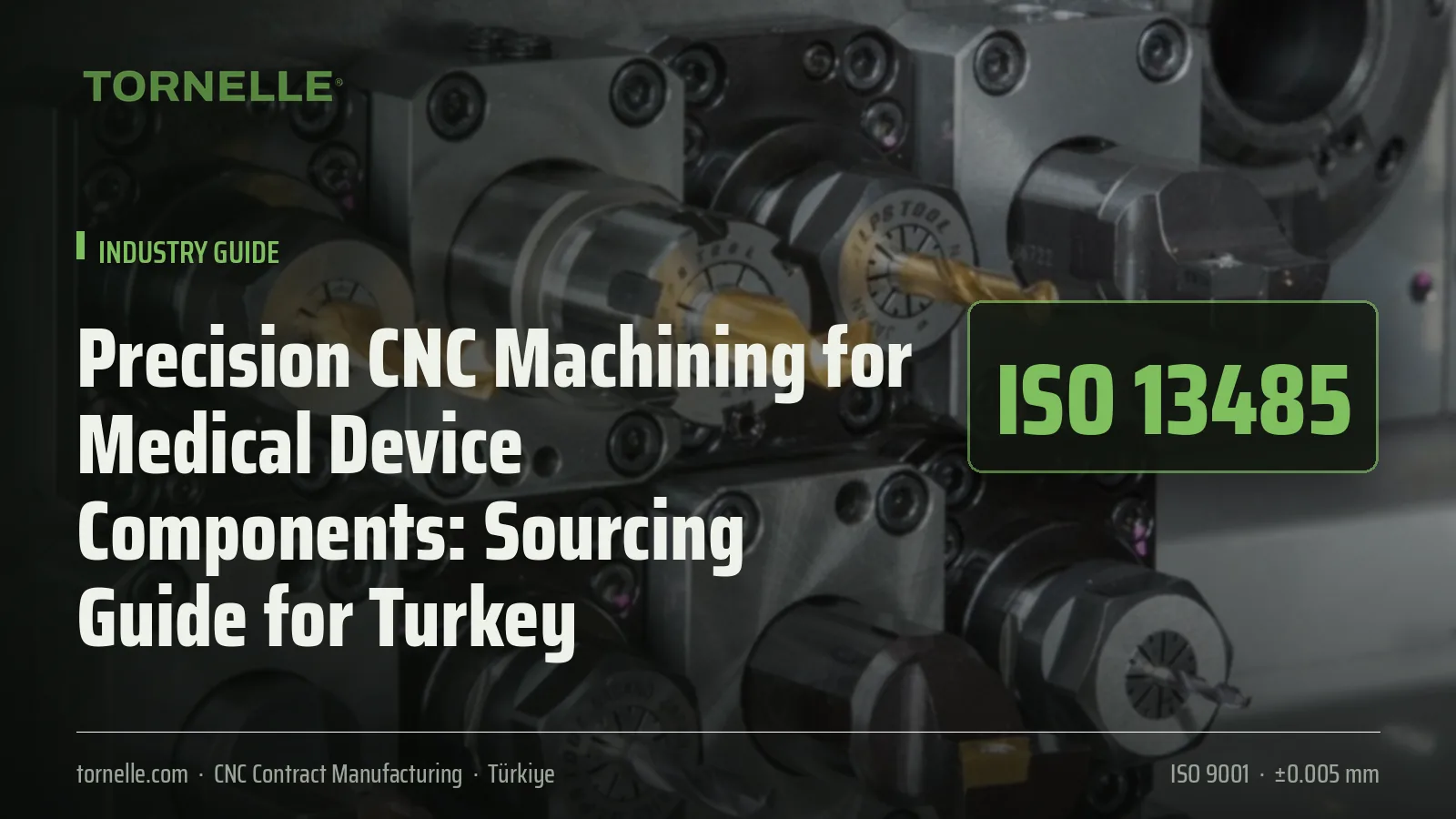
After automotive, the medical device sector has the second strictest documentation expectations in machining; but "medical part" is not a single category. There is a regulatory chasm between the aluminium bracket of an MRI scanner and a hip implant. Medical manufacturers who make this distinction correctly source a significant share of their components from nearby, economical CNC sources such as Turkey. For Turkey's general advantages see our guide, and for country-specific processes our Switzerland and Germany articles.
Which Medical Parts Are Suited to Subcontracting?
| Part class | Examples | Suitability for subcontracting | Typical supplier requirement |
|---|---|---|---|
| Device mechanics (no patient contact) | Chassis, brackets, slides, shafts, gears, covers, connector bodies (imaging, laboratory, dental units, patient beds) | High | ISO 9001, the manufacturer's supplier control, FAI, material certificate |
| Fluid systems | Pump bodies, valve components, manifolds (dialysis, infusion, analytical instruments) | High | The above + technical cleanliness, leak testing |
| Surgical instrument components (reusable) | Handles, shafts, adapters, screwdriver tips | Medium–high | Experience with 1.4021/1.4034/1.4441, passivation, traceability; most manufacturers prefer an ISO 13485 supplier |
| Single-use instrument parts | Guides, connecting parts | Medium | Process validation, cleanliness, batch traceability |
| Implants and permanent contact | Orthopaedic implants, dental implants, screws | Low (specialist supplier) | ISO 13485, full validation, clean room, biocompatibility chain; outside Tornelle's scope |
| Prototypes and test fixtures | Design verification prototypes, test rigs, production fixtures | High | Speed and flexibility; low regulatory requirement |
Rule: If the part does not contact the patient, or only for a short time, and the manufacturer controls the part as a "purchased component" within its own ISO 13485 system, a qualified ISO 9001 subcontract shop is a suitable supplier. Implants and long-term contact parts are the domain of ISO 13485-certified specialist suppliers.
Regulatory Framework: MDR and Supplier Control
The EU Medical Device Regulation (MDR 2017/745) and ISO 13485 place responsibility on the device manufacturer (legal manufacturer); the subcontract shop is managed as a "critical supplier" or "supplier" within the manufacturer's quality system. What the manufacturer expects from the subcontractor:
- Supplier evaluation and audit: Questionnaire, document review, on-site or video audit; inclusion on the approved supplier list.
- Quality agreement: Change notification (material, process, sub-supplier, machine), record retention period (device lifetime + typically 10–15 years), complaint and CAPA cooperation, right of audit.
- Evidence of conformity to specification: FAI, inspection reports, material certificates (3.1), surface treatment reports.
- Traceability: Each batch → material heat number → process records; marking support (laser marking) for parts requiring UDI.
- No unauthorised process changes: No unannounced changes to the approved process (material, cutting parameters, surface treatment supplier).
An ISO 13485 certificate for the subcontract shop is not mandatory within this framework, but may be preferred depending on the manufacturer's risk class. Tornelle is not ISO 13485-certified; it works under the manufacturer's supplier control for non-patient-contact components, fluid system parts, prototypes and fixtures. The difference is explained in our ISO 9001 versus ISO 13485 article.
Machining Medical Materials
- Stainless steel 1.4404 (316L) and 1.4435: Device bodies, fluid parts; medium machinability, passivation (ASTM A967) and electropolishing are common. Details in our stainless steel guide.
- 1.4441 (316LVM) and martensitic 1.4021/1.4034/1.4197: Surgical instruments; heat treatment and grinding chain for hardenable grades.
- Titanium Grade 2 and Grade 5 (Ti6Al4V), Grade 23 (ELI): Low cutting speed, sharp tools, good cooling; suitable for subcontracting in non-implant applications (instruments, device parts). Material certificate to ASTM F67/F136.
- Aluminium 6082/6061/7075: Device chassis, brackets; anodising (Type II/III) and coloured anodising.
- PEEK, POM-C, PTFE, PSU: Insulation, guide and fluid parts; thermal stress relief for dimensional stability; medical grade (non-implant) or USP Class VI material certificate.
- Brass and copper: Connectors and valves; nickel plating and lead-free grades (CW511L) may be required.
Surface, Cleanliness and Marking
- Surface roughness: Ra 0.8 or below on fluid-contact surfaces; Ra 0.4–0.8 typical for cleanability. Electropolishing roughly halves Ra. Details in our Ra/Rz article.
- Edge quality: Burr-free, defined edge break (0.1–0.3 mm); a defined process (brushing, vibratory finishing, electrochemical) rather than manual deburring.
- Technical cleanliness: Delivery free of oil and particles; ultrasonic cleaning, defined cleanliness class (VDA 19 / ISO 16232 or customer specification), clean packaging. Explained in our packaging article.
- Marking: Part number, batch, UDI-DI/PI by laser marking; marking location and depth on the drawing.
- Passivation and electropolishing: At approved sub-suppliers, with certificate.
Process Validation and Statistics
Medical manufacturers may require process capability on critical features (Cpk ≥ 1.33, 1.67 at some manufacturers) and measurement system analysis (Gage R&R); the expectation of validation (IQ/OQ/PQ) for processes whose "output cannot be fully measured", such as surface treatment and cleaning, varies by manufacturer. What the subcontract shop must provide: control plan, measurement data, stable process parameters and change control. Tornelle carries out this work according to the customer specification; the device manufacturer owns the validation protocols.
Turkey's Position in the Medical Sector
Turkey is a growing manufacturer and exporter of surgical instruments, patient beds, dental units, sterilisation equipment and single-use products (the Samsun surgical instrument cluster, device manufacturers in Istanbul and Ankara). This means medical material supply (1.4404, titanium, PEEK) is possible locally, sub-processes such as passivation and electropolishing are available, and medical documentation discipline is familiar. Duty-free entry into the EU under A.TR and 3–7 days by road also make supplier audits easier for the medical manufacturer (a day trip by air to Istanbul).
Checklist for the Medical Manufacturer
- Classify the part: no patient contact / transient contact / permanent contact. Suitability for subcontracting depends on this.
- Supplier questionnaire and document review; ISO 9001 verification; video or on-site audit.
- Quality agreement: change notification, record retention, right of audit, CAPA cooperation.
- Write the specification completely: material + certificate standard, surface, cleanliness, marking, packaging.
- Sample approval with FAI + material certificate + surface treatment report.
- Cpk and control plan on critical features; sampling report on series batches.
- Annual supplier evaluation and re-audit.
Frequently Asked Questions
Can I buy medical parts from a shop without ISO 13485 certification?
Yes, for non-patient-contact components, fluid system parts, prototypes and fixtures; the part is controlled as a "purchased component" within your ISO 13485 system. Implants and permanent contact parts require an ISO 13485-certified specialist supplier.
Can titanium parts be machined in Turkey?
Yes; Grade 2 and Grade 5 titanium are machined from material certified to ASTM F67/F136. Non-implant applications (instruments, device parts) are suitable for subcontracting.
How long are records retained?
Defined in the quality agreement; typically 10–15 years for medical parts. Batch records, certificates and inspection reports are archived electronically.
When is a change notification required?
For changes to the material supplier, surface treatment sub-supplier, machine, critical cutting parameters or measurement method; defined as a list in the quality agreement and not implemented without customer approval.
Conclusion
The majority of medical device components can be produced economically and safely in qualified CNC subcontract shops, given correct classification and the manufacturer's supplier control. Tornelle works in 1.4404, titanium, aluminium and engineering plastics for non-patient-contact mechanical components, fluid system parts, surgical instrument components (with manufacturer approval), prototypes and fixtures; implants are outside our scope. To evaluate the suitability of your part, send your technical drawings, material and documentation expectations via our quote form; we will also complete your supplier questionnaire.