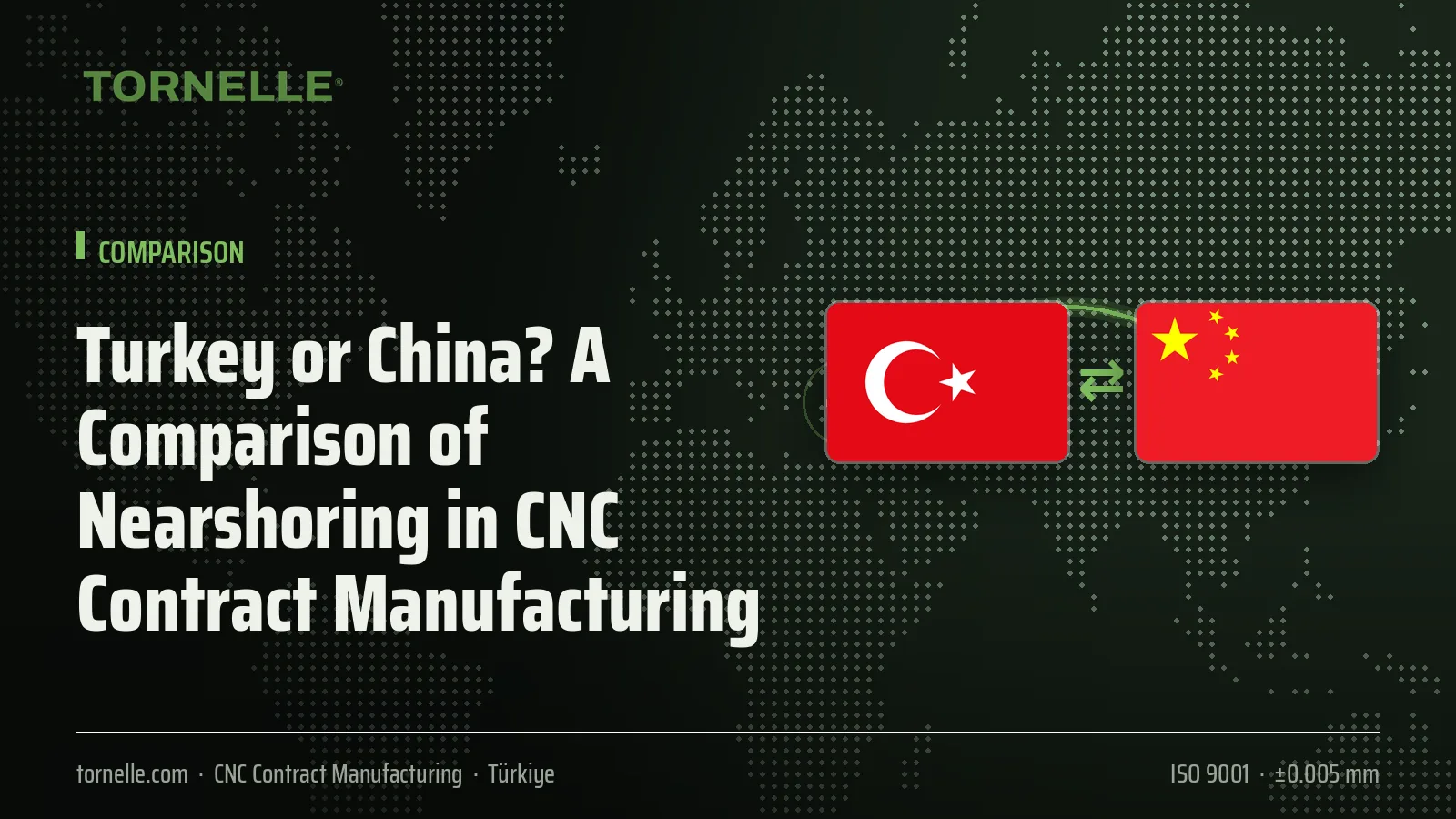
The classic question facing purchasing departments in Europe: Should CNC parts be sourced from China or Turkey? China generally offers the lowest unit price, while Turkey promises proximity to Europe, duty-free trade, and speed. To make the right decision, one must look not at the unit price but at the total cost of ownership (TCO) and the risk profile. Below, we compare the two countries across 10 criteria.
1. Unit Price
China: The unit price is generally the lowest for simple, high-volume, and material-intensive parts. Turkey: For labor-intensive, multi-operation, and tight-tolerance parts, prices are comparable to China’s; for simple parts, they may be 5–15% higher. However, rising labor costs and exchange rate fluctuations in China in recent years have narrowed this gap. Unit price is just one component of TCO.
2. Customs Duties
China: For imports into the EU, processed metal parts typically face a 2.7%–4.7% customs duty; there is a risk of anti-dumping duties on certain product groups. Turkey: Zero customs duty under the Customs Union with an A.TR certificate; a Free Trade Agreement (FTA) with the UK and agreements with EFTA countries are in place.
3. Shipping Time
China: Sea freight takes 30–45 days plus port and customs clearance; total of 6–8 weeks. Air freight is fast but expensive. Turkey: Road transport to Central Europe takes 4–6 business days; air freight takes 1–2 days. Details: logistics guide.
4. Shipping Costs and Volatility
China: Container freight rates can fluctuate by 3–5 times within a few months depending on geopolitical events and capacity (examples: the 2021 and 2024 Red Sea crises). Turkey: Road freight rates are relatively stable; small shipments can be transported economically via LCL (groupage) shipments.
5. Inventory and Working Capital
An 8-week lead time implies an equal amount of safety stock and capital tied up in transit. With a 1-week lead time, inventory levels and warehouse costs drop dramatically. For a company purchasing 500,000 € worth of parts annually, capital tied up in transit and in inventory for Chinese sourcing typically exceeds 100,000 €; in Turkey, this figure drops to one-fifth of that amount.
6. Minimum Order Quantity (MOQ)
China: High MOQs are common due to shipping economics and the supplier structure; small batches are expensive. Turkey: Prototypes and batches of 10–500 units can be produced cost-effectively; small, on-demand batches are transported seamlessly by road.
7. Quality and Standards
China: Excellent suppliers are available, but the cost of selection and inspection is high; conversion from GB standards to DIN/ISO and material equivalence (e.g., 316L-like alloys instead of 1.4404) require careful attention. Remote monitoring and third-party inspection incur additional costs. Turkey: DIN/ISO/EN standards are standard practice; European material numbers are sourced directly; the EN 10204 3.1 certificate is standard. See the quality assurance guide.
8. Claims and Replacement Timeframes
When a defective batch arrives from China, rectification or remanufacturing takes 8–10 weeks; in most cases, the parts are reworked or scrapped in Europe. In Turkey, rectified parts are delivered within 1–2 weeks; the 8D process is carried out within the same timeframe.
9. Communication and Time Zone
China: 6–7-hour time difference; working hours almost never overlap, so questions are carried over to the next day; technical communication is mostly handled through the sales representative. Turkey: 1–2-hour time difference; video calls with the engineer on the same day; technical communication in English and German.
10. Intellectual Property and Contract Security
In Turkey, NDAs and quality agreements are enforced in a manner similar to European legal practice; arbitration and the enforceability of European court rulings are stronger in the event of disputes. In China, protecting technical data requires additional measures.
Comparison Table
| Criterion | China | Turkey |
|---|---|---|
| Unit price (simple part) | Lowest | 5–15% or more |
| Unit price (complex part) | Low | Similar |
| Customs duty (EU) | 2.7–4.7% + risk of anti-dumping duties | 0% (A.TR) |
| Shipping time | 6–8 weeks | 4–6 business days |
| Freight rate stability | Low | High |
| MOQ | High | Low |
| Standards | GB → DIN/ISO Conversion | DIN/ISO Direct |
| Claim Period | 8–10 weeks | 1–2 weeks |
| Time difference | 6–7 hours | 1–2 hours |
| Visit | 10+ hours flight, multiple days | 3-hour flight, single day |
Numerical Example: Total Cost of Ownership
20,000 units per year, aluminum milled brackets, delivered to Germany:
- China: unit cost 4.20 € + 3% customs duty 0.13 € + freight/insurance 0.35 € + inventory/capital cost 0.25 € + inspection and quality risk 0.20 € = ≈5.13 €
- Turkey: 4.60 € per unit + customs duty 0 € + freight 0.15 € + inventory/capital cost 0.06 € + quality risk 0.05 € = ≈4.86 €
These figures are for illustrative purposes only and vary by part; however, the logic is clear: a 10% difference in unit price results in the opposite effect on TCO. Turkey’s advantage becomes even more pronounced with complex parts.
When Does China Still Make Sense?
China can remain competitive for parts with very high volumes (hundreds of thousands), simple designs, low quality risk, and non-critical lead times. Many European companies today employ a dual strategy: standard, high-volume parts from China, and critical/complex/variable parts from Turkey. Turkey’s advantages, as outlined in our comprehensive guide, help balance the risks in this dual model.
Frequently Asked Questions
Is Turkey more expensive than China?
The unit price may be slightly higher for simple parts; however, when customs duties, shipping, inventory, and quality risk are factored in, the total cost is usually in Turkey’s favor.
Is it difficult to transport parts sourced from China to Turkey?
No. An RFQ is prepared using existing technical drawings and samples; thanks to DIN/ISO compliance, no standard conversion is required. The transition with a pilot batch is completed in 4–8 weeks.
Is there sufficient capacity in Turkey?
Yes. Turkey’s machining capacity has been growing for decades across the automotive, home appliance, defense, and machinery industries; export-oriented suppliers have scaled their operations to meet European demand.
Conclusion
The answer to the question “Turkey or China?” depends on the part type and your supply strategy; however, for CNC contract manufacturing targeting Europe, most criteria—including total cost, speed, quality assurance, and risk—favor Turkey. If you’d like to receive a comparative quote for your current parts, please send us your technical drawings.