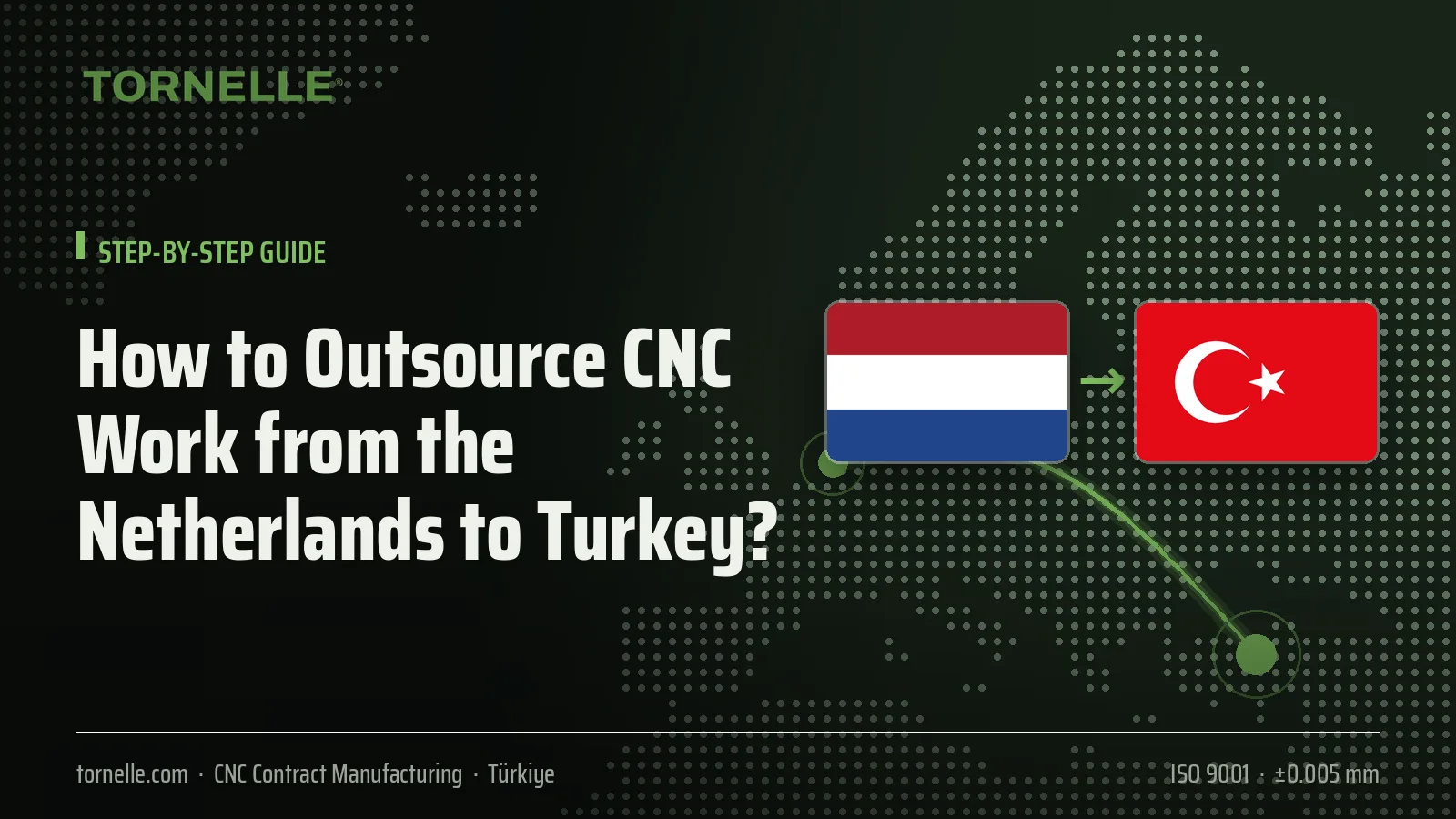
After exploring the advantages of outsourcing CNC work from the Netherlands to Turkey, this guide explains how to carry out the process in practice—following the clear and pragmatic workflow familiar to Dutch procurement teams: quote request, quote, sampling, approval, and series production.
Step 1: Documentation
- Technical drawing (PDF): In accordance with the NEN-EN-ISO standard; general tolerances (ISO 2768-mK/fH), critical dimensions, surface roughness (Ra), edge rounding, and threads. Notes in Dutch are acceptable.
- 3D model (STEP): For pricing and CAM.
- Material: EN number (1.4404, 1.4305, 42CrMo4, EN AW-6082/7075) and certificate type (EN 10204 3.1).
- Surface and heat treatment: Anodizing, passivation, chemical nickel plating, hardening.
- Cleaning and packaging requirements: Particularly important for high-tech applications; specify in the RFQ.
- Quantity and scheduling: Annual forecast, lot size, first delivery date.
Detailed list: RFQ preparation guide.
Step 2: Quotation and Comparison
Turkish suppliers will submit quotes within 1–3 business days. The quote must include quantity tiers, setup costs, scope of reports/certificates, delivery time, Incoterms, and DFM recommendations. Compare quotes based on total cost: including shipping, customs brokerage, payment terms, and inventory costs.
Step 3: Commercial Terms
Incoterms
FCA Istanbul (shipped by your own freight forwarder) or DAP (delivered by the supplier to your doorstep). The import declaration and VAT remain the responsibility of the Dutch party.
Payment
30–50% advance payment on the first order, with the balance due before shipment; 30–60-day payment terms for ongoing business relationships. Prices are in euros; no currency risk.
Contracts
Non-disclosure agreement (NDA) prior to technical data exchange; quality agreement and framework agreement for serial supply.
Step 4: Sample and Approval
Receive a pre-production sample or pilot batch, accompanied by a measurement report (CMM), a 3.1 certificate, and, if required, a coating certificate. FAI and cleaning protocols may be required in the semiconductor and high-tech sectors, and PPAP may be required in the automotive sector. Quality steps: quality assurance guide.
Step 5: Customs and VAT
Imports from Turkey to the Netherlands are exempt from customs duties under the Customs Union with an A.TR certificate. Required documents:
- EORI number (starting with NL).
- Commercial invoice — HS code, Incoterms, value.
- A.TR movement certificate — issued by the Turkish exporter.
- Packing list and CMR or AWB.
- Import declaration — submitted by the freight forwarder or your customs broker.
VAT: With an Article 23 permit, import VAT is not paid at customs; it is declared on the VAT return and offset. If you do not have a permit, applying to the Belastingdienst is straightforward and standard procedure for companies that import regularly.
Step 6: Serial Deliveries
- Framework Agreement + Call-Off Orders: Fixed annual quantity, delivered via monthly call-offs.
- Safety stock: 2–4 weeks’ worth of stock held by the supplier; since road transport takes 4–5 days, the effective lead time is significantly reduced.
- Consolidated shipments: Combine multiple part numbers.
Shipping options: logistics guide.
Common Mistakes
- Starting regular imports without Article 23 authorization — unnecessary VAT cash outflow;
- Failing to specify cleaning and packaging requirements in the RFQ;
- Setting tolerances too narrowly;
- Failing to document acceptance criteria in writing;
- Skipping the sample phase.
Frequently Asked Questions
Can I submit technical drawings in Dutch?
Yes. Standard notation is based on European standards; technical communication is conducted in English.
Do I need to pay import VAT in advance?
No, if you have an Article 23 permit; the VAT is declared on the tax return and offset at the same time.
How long does the first order take?
For samples: 1–2 weeks production + 2–5 days shipping; for production runs: 3–6 weeks production + 4–5 days by road.
Is cleanroom or special packaging available?
Requirements such as oil-free cleaning, VCI packaging, and separate packaging per part can be accommodated if specified in the RFQ.
Conclusion
Outsourcing CNC machining from the Netherlands to Turkey is just as seamless as intra-European sourcing—provided you have the correct files, clear Incoterms, and an A.TR certificate. Send us your technical drawings and receive a quote within 24 hours.