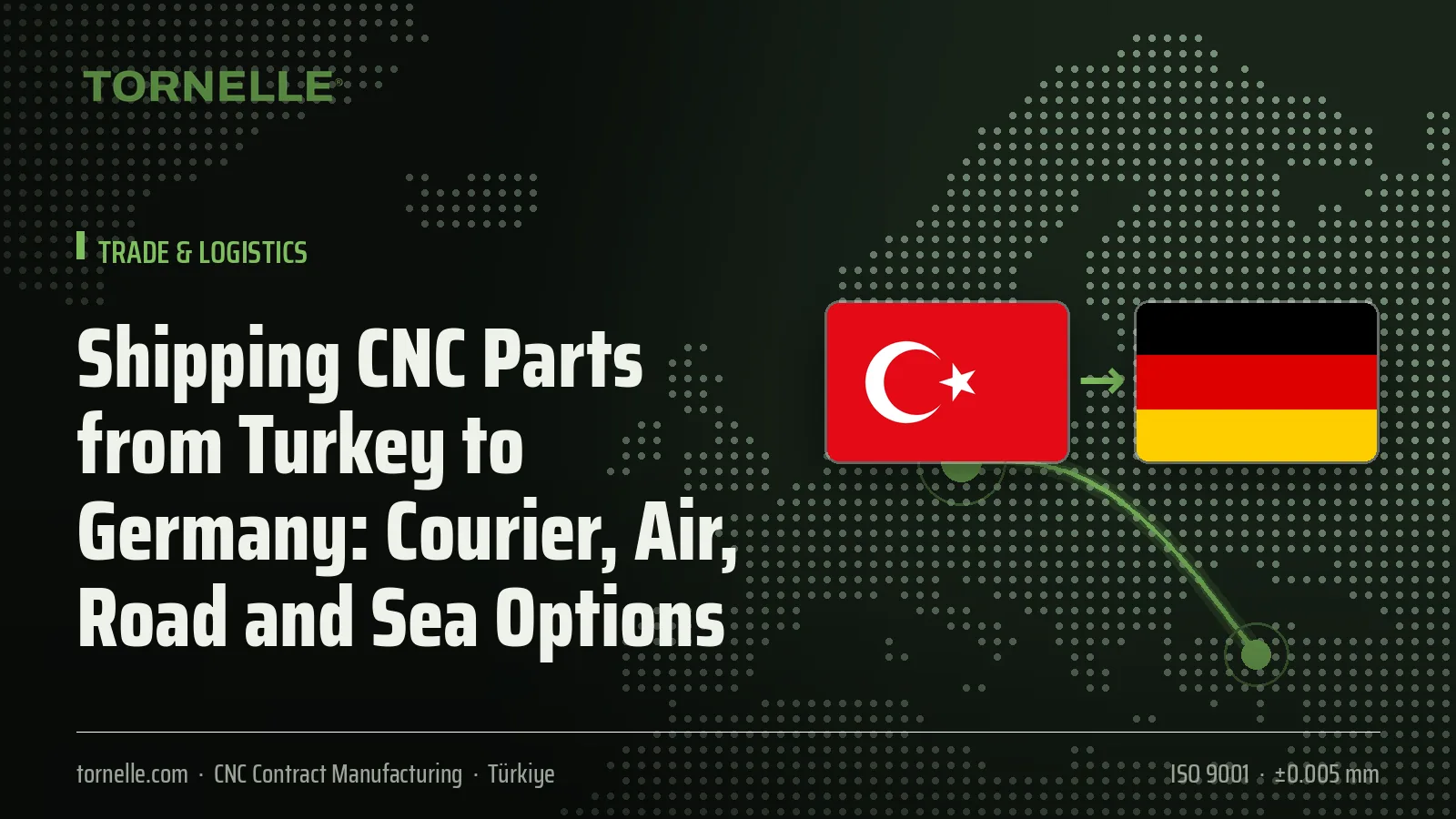
In our European logistics guide we gave the general framework; this article is a practical shipping guide for Germany, Turkey's largest CNC parts market. It deepens the logistics step of our Germany process article.
Four Options at a Glance
| Method | Door-to-door time | Suitable load | Cost logic | Typical use |
|---|---|---|---|---|
| Express courier (DHL Express, UPS, FedEx/TNT) | 2–3 working days | 0.5–70 kg, parcels | Weight/volume tiered; 5 kg ≈ €40–70, 30 kg ≈ €120–200 | Samples, FAI parts, urgent top-up shipments |
| Air freight (IST/SAW → FRA/MUC/DUS) | 2–4 working days (flight 3 hours; handling and customs 1–2 days) | 50–1,000 kg | Per kg €2.5–4.5 + fixed charges (€150–300) | Urgent series batches, high-value small parts |
| Road groupage (LTL / Sammelgut) | 4–6 working days | 1–10 pallets, 100–3,000 kg | Per pallet or loading metre; 1 pallet ≈ €180–300, 3 pallets ≈ €400–650 | Standard series shipment |
| Road full truck (FTL) | 3–5 working days | 20–33 pallets, 10–24 tonnes | Per vehicle; Istanbul–Stuttgart ≈ €2,800–4,000 | Large call-off orders, heavy casting batches |
| Sea freight (Istanbul/Gemlik → Hamburg/Bremerhaven) | 16–22 days | LCL 1–10 m³ or 20'/40' container | LCL ≈ €60–100/m³ + port charges; 20' ≈ €1,200–2,000 | Heavy, bulky, non-time-critical loads |
The figures are typical market values for 2025–2026; they vary with fuel surcharge, season and route. Southern Germany (Stuttgart, Munich) is the destination closest to Istanbul; add one day for Hamburg and Berlin.
1. Express Courier
The standard route for samples and FAI parts. DHL Express and UPS deliver from Istanbul to Germany within 2 working days; TNT/FedEx 2–3 days. The courier handles customs clearance; the A.TR document is attached to the parcel, and the consignee's EORI number and VAT number are written on the waybill. Courier companies pay import VAT on behalf of the consignee and collect it (+ service fee €10–20); if the consignee wishes to use its own customs broker, this must be notified in advance. Volumetric weight (length×width×height/5000) determines the price; for light but bulky parts, air freight or road may be more economical. At Tornelle, sample shipments are sent by DHL Express as standard.
2. Air Freight
For urgent loads above 50 kg, courier prices rise quickly; air freight (via a forwarder) is cheaper per kg, but fixed charges (terminal, documents, customs) and delivery from the airport are added. Istanbul–Frankfurt has dozens of flights per day; 2–4 working days in total. Suitable scenario: an urgent 200 kg batch to prevent a line stoppage, or valuable small parts (if the part value exceeds €200 per kg, the air freight cost stays below 2% of value).
3. Road: Groupage and Full Truck
Turkey–Germany road transport is the backbone of the CNC parts trade. Many groupage departures leave Istanbul for southern and western Germany every week; the load is consolidated at the forwarder's warehouse in Istanbul and travels via Bulgaria–Serbia–Hungary–Austria (or Romania), or by Ro-Ro to Trieste and from there to Germany. Door to door 4–6 working days; the distribution network in Germany (Sammelgut) makes the final delivery. Practical points:
- Cut-off day: Most forwarders have a weekly cut-off (e.g. cargo acceptance Thursday, departure Friday); planning production around the cut-off saves 2–3 days.
- Pallet pricing: Per Euro pallet (800×1200) or per loading metre (ldm); heights above 1.2 m and non-stackable pallets incur surcharges. Fit the boxes to the pallet footprint. Details are in our packaging article.
- Border crossings: Kapıkule and the Serbia–Hungary border experience congestion; the 1–2 day deviations in transit times come from here. With a T1 transit document the load travels under customs control up to the EU.
- FTL: For loads above 10 tonnes or 15+ pallets, a full truck is both faster (3–5 days, no transhipment) and favourable in unit cost.
- No refrigerated/special vehicle is needed; CNC parts travel in standard curtain-sided trucks; only VCI and moisture protection are required.
4. Sea Freight
Direct or transhipment container services from Istanbul to Hamburg and Bremerhaven take 12–16 days port to port; door to door 16–22 days. A 20' container takes up to 20 tonnes. For heavy machined-casting batches, bulky aluminium profiles or monthly consolidated shipments, the unit cost falls to 40–60% of road. Disadvantage: transit time and port handling complexity; for southern Germany, 700 km of additional road from Hamburg. It makes sense for buyers in northern Germany and for stock-based supply relationships.
Customs in Germany: ATLAS, A.TR, EORI, EUSt
- Documents: Commercial invoice (EUR, HS code, origin, Incoterm, consignee EORI/USt-IdNr.), packing list, A.TR movement certificate, CMR (road) or AWB/B/L.
- Declaration: The forwarder or customs broker lodges the import declaration in the ATLAS system; the consignee's EORI number and a power of attorney (Vollmacht) are required. For DAP deliveries the supplier's forwarder does this on behalf of the consignee; the fee is €40–80 per shipment.
- Customs duty: 0% with A.TR. If the A.TR is missing, the third-country tariff applies (mostly 1.7–3.7% for machined metal parts); subsequent correction is possible but laborious; make sure the document travels with the goods.
- Import VAT (EUSt, 19%): In Germany EUSt is assessed at customs; since 2020 payment is deferred to the 26th of the second following month (Zahlungsaufschub, via the forwarder's deferment account); the consignee deducts the EUSt in the Umsatzsteuer-Voranmeldung. Result: the temporary cash effect is small. The forwarder may charge an additional fee (1–2% or fixed) for paying EUSt on the consignee's behalf; the consignee can eliminate this with its own Aufschubkonto.
- Intrastat: As Turkey is outside the EU, no Intrastat declaration is made; the import declaration is sufficient.
Insurance and Liability
In road transport, carrier liability under the CMR Convention is limited to 8.33 SDR per kg (approximately €10); for CNC parts with a high value per kg this is insufficient. Additional cargo insurance (Warentransportversicherung) costs 0.1–0.3% of the cargo value and is recommended; the Incoterm determines who arranges it (the seller under DAP, the buyer under FCA; insurance is only mandatory under CIF/CIP). In case of damage, a reservation must be written on the CMR at delivery and written notification given within 7 days; pre-shipment packaging photos serve as evidence.
Delivery Practices
- Notification and appointment: German warehouses mostly require a delivery appointment (Avisierung); the forwarder must be given the consignee's warehouse hours and contact details.
- Tracking: Couriers and most forwarders provide online tracking; for road transport, request notifications of customs departure and border crossing.
- Holidays: Religious holidays in Turkey (twice a year, 3–9 days) and state holidays in Germany can shift shipments by 2–5 days; an annual calendar is shared.
- Packaging: ISPM 15 stamped pallet, VCI, pallet label, document pouch; delivery note and inspection report with the package or in advance by e-mail.
- Incoterm: DAP is the most common choice for Germany; FCA Istanbul if the buyer has a forwarder agreement. A comparison is in our Incoterms guide.
Decision Table
| Situation | Recommended method |
|---|---|
| Samples, FAI parts, < 30 kg | Express courier (2–3 days) |
| Urgent series batch, 50–500 kg, risk of line stoppage | Air freight (2–4 days) or express courier multi-parcel |
| Regular series batch, 1–10 pallets | Road groupage (4–6 days), production plan aligned to the weekly cut-off |
| Large call-off order, 15+ pallets or 10+ tonnes | Full truck (3–5 days) |
| Heavy castings/bulky load, not time-critical, northern Germany | Sea freight Hamburg (16–22 days) |
| 12 shipments per year, low-value parts | Monthly consolidated groupage + 3–4 weeks safety stock |
Frequently Asked Questions
Are there customs problems when shipping samples?
No; with a commercial invoice ("samples, commercial value … €") and A.TR, the courier completes customs in 1 day. The value must not be written as zero; the real value is declared.
Who should organise the transport?
On first orders, DAP (the supplier organises) is the option with the fewest surprises; at regular volumes, switch to FCA if the buyer's forwarder agreement is cheaper.
Are 4–6 days by road guaranteed?
It is the typical time; border congestion and holidays can cause 1–2 days of deviation. Leave a one-week margin for critical deliveries or use air freight.
Do I need to set aside cash for EUSt?
With a deferment account, EUSt is paid on the 26th of the second following month and deducted in the VAT return; the temporary cash effect is small. Do not forget to ask about the forwarder's payment service fee.
Conclusion
The standard route for shipping CNC parts from Turkey to Germany is weekly road groupage (4–6 days); samples go by courier in 2–3 days, urgent batches by air freight, heavy loads by sea. Customs duty is zero with A.TR, EUSt is deferred and deducted; additional cargo insurance and correct packaging close the risk. Tornelle organises the forwarder, documents and ATLAS declaration for DAP deliveries. For a quote including a shipping plan, send your technical drawings and quantity information via our quote form.