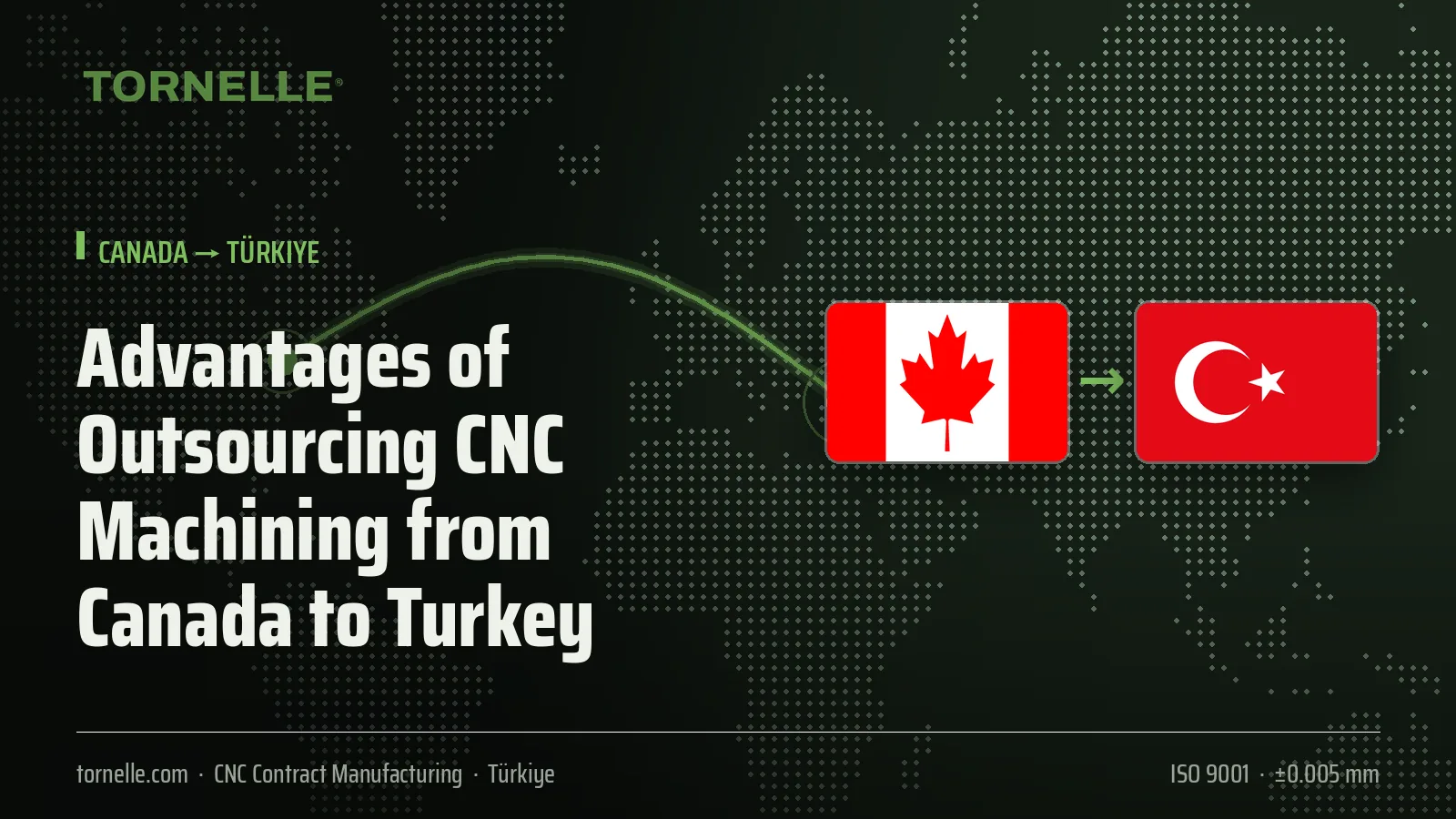
For many years Canadian manufacturers chose between the USA and China for CNC part sourcing. In recent years, uncertainty in trade with the USA and the wish to reduce dependence on China have led Canadian buyers to look for a third source. As a NATO ally and a member of the customs union with the EU, Turkey combines European quality standards with competitive cost. In this article we look at the advantages of CNC contract manufacturing in Turkey for Canadian buyers and the points to watch.
1. Cost: 35–50% Savings
CNC machine hourly rates in Canada are in the CAD 85–130 range depending on the province; in Turkey they are €28–45 (roughly CAD 42–68) for 3-axis turning and milling. For labour-intensive parts, total savings including air or sea freight and customs are around 35–50%. For material-heavy parts the gap narrows. You can find our line-by-line calculation approach in our cost comparison article.
2. An Alternative to China: Shorter Time, Lower Risk
Sea transport from China to Canada takes 30–45 days, and in the event of a revision, a quality problem or a repeat order this period is experienced twice. From Turkey, air freight to Montreal or Toronto takes 3–5 days and sea freight 18–28 days. In addition, intellectual property protection in Turkey is close to the European legal system, and the communication, time-zone and sample-approval-loop problems Canadian buyers experience with Chinese sourcing are far less severe. The full comparison is in our article Turkey or China.
3. Inch Drawings and North American Standards
Because Canadian industry is integrated with the US supply chain, inch-unit drawings, ASME Y14.5 GD&T, UNC/UNF threads and AISI/SAE material designations are common. Export-oriented Turkish workshops are used to working with these drawings: CAM programs are prepared in inch units, UNC/UNF threading tools are in stock, and grades such as AISI 1045/4140/303/316 are sourced with their EN equivalents. The step-by-step guide we wrote for US buyers is largely applicable to Canadian teams as well.
4. Customs and Taxes: A Realistic View
There is no free trade agreement between Turkey and Canada; parts of Turkish origin are subject to Canada's MFN (most-favoured-nation) tariff. For many machine parts and components this rate is 0%; in some tariff lines there may be customs duty between 0% and 6.5%. We recommend clarifying the correct HS classification with your customs broker at the quotation stage. 5% GST (HST in some provinces) is paid on import and is recoverable for businesses. An important note: when you export your final product to the USA, parts made in Turkey count as "non-originating" content in the CUSMA origin calculation; take this into account for products operating close to the regional value content threshold.
5. Sector Fit
- Aerospace (Montreal cluster): precision parts in aluminium and stainless steel; special process approvals and full traceability are required, and supplier qualification must be verified in advance.
- Mining and oil and gas equipment: alloy steel shafts, bushings, valve and pump components, hydraulic blocks; material certificates are standard.
- Agricultural machinery: heavy turned parts, pins, gear housings.
- Automotive (Ontario): PPAP culture, series turned and milled parts, Swiss-type turned components.
- Electronics and telecom: aluminium housings, connectors and brass parts.
6. Logistics Options
- Air freight: direct flights from Istanbul to Toronto and Montreal; door to door in 3–5 days. The most common option for high-value, low-volume batches.
- Sea freight (container/LCL): 18–28 days from Istanbul or Izmir to Montreal and Halifax; the most economical for planned series shipments.
- Express courier: 2–4 days for samples and urgent small batches.
If sea freight is preferred, corrosion protection (VCI packaging, desiccant) should be planned.
7. Communication and Time Difference
There is a 7-hour time difference between Turkey and Eastern Canada and 10 hours with Western Canada. The Canadian morning coincides with the end of the working day in Turkey; a daily two-to-three-hour shared window and disciplined written communication are therefore important. Technical communication in English is standard; drawing notes in French are not a problem either, because dimensions and symbols are ISO/ASME based.
Points to Consider
- Confirm the HS code and the customs duty rate with your customs broker at the quotation stage.
- Assess parts within the scope of controlled technology (ITAR/CGP) from an export control perspective.
- Clarify the delivery term (FCA Istanbul or DAP Toronto) and the transport mode; our Incoterms guide will help.
- Plan a sample and inspection report step for the first order; define your quality assurance expectations in writing.
Frequently Asked Questions
Is customs duty paid on imports into Canada?
As there is no free trade agreement, the MFN tariff applies; 0% for many machine parts, 0–6.5% for some. It depends on the HS code; confirm with your broker.
What is the lead time?
Production 2–5 weeks; air freight 3–5 days, sea freight 18–28 days.
Are inch-unit drawings accepted?
Yes. Inch drawings, ASME GD&T and UNC/UNF threads are standard in export-oriented Turkish workshops.
In which currency are prices quoted?
USD or euros; on request the CAD equivalent is added for reference.
Conclusion
For Canadian companies Turkey offers shorter lead times and lower risk than China, a clear cost advantage over the USA, fluency with inch drawings and a European quality culture. Send your technical drawings and annual quantity forecast via our quote form; you will receive an itemised, USD-based quote within 24 hours.