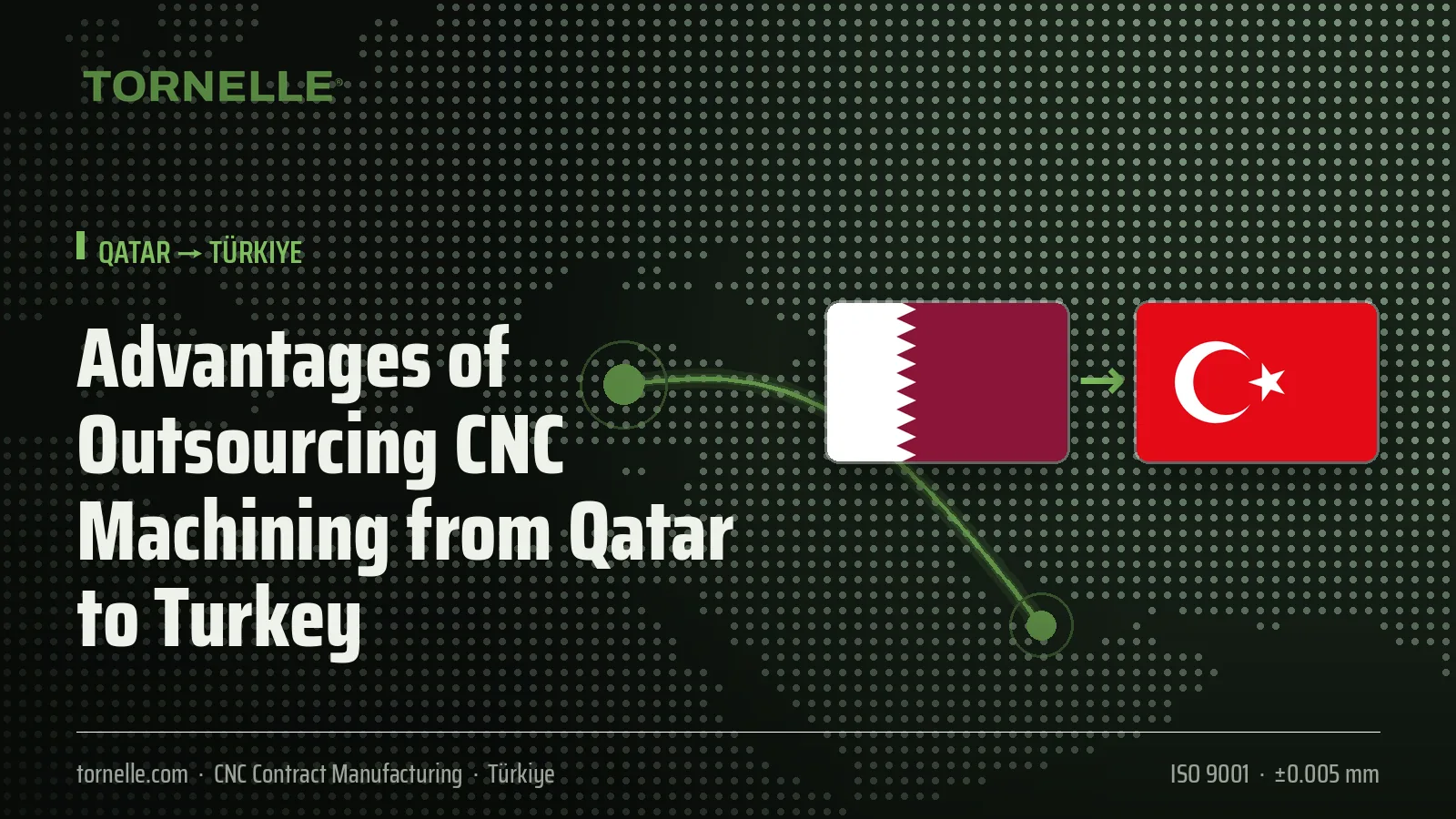
Despite its small land area, Qatar has a very dense industrial infrastructure with LNG production and liquefaction plants, petrochemical complexes, aluminium smelting, desalination and power plants. The maintenance and refurbishment needs of these facilities create demand for certified, traceable CNC parts in stainless steel, duplex, alloy steel and nickel alloys. Local machining capacity, however, is limited. In this article we look at the advantages of CNC contract manufacturing in Turkey for Qatari buyers.
1. Same Time Zone, 2–3-Day Freight
Turkey and Qatar are in the same time zone (UTC+3); technical questions are answered within the same working day. There are many direct flights a day between Istanbul and Doha, and Doha is one of the world's largest air cargo hubs; door-to-door air freight takes 2–3 days. For planned high volumes, sea freight from Mersin or Istanbul to Hamad Port takes 12–18 days. Compared with sourcing from Europe, Turkey is both closer and faster.
2. Strong Commercial and Cultural Ties
Turkey–Qatar relations have deepened rapidly in the economic and commercial sphere over the past decade; Turkish contracting and industrial companies are actively involved in infrastructure and energy projects in Qatar. This proximity means trust, ease of payment and fast decisions in supply relationships. Technical communication in English is standard; support for commercial communication in Arabic is widely available in Turkey.
3. Cost: European Quality, Lower Price
Qatari companies mostly source technical CNC parts from Europe or through regional distributors at high prices and with long lead times. In Turkey, 3-axis turning and milling hourly rates are in the €28–45 band, 30–50% below Western Europe. Documentation and quality standards are the same. Working directly with the manufacturer also eliminates the distributor margin. For the calculation approach see our cost comparison article.
4. Customs and Taxes
There is no free trade agreement in force between Turkey and Qatar; parts of Turkish origin are subject to the GCC common tariff, typically 5% for industrial machine parts. At the time of writing, VAT is not applied in Qatar; confirm the current situation with your customs broker. Because these conditions are the same as for sourcing from Europe, they do not affect Turkey's price advantage.
5. Sector Fit
- LNG and oil and gas: valve and pump components, flanges, instrumentation housings, fittings. Materials: 316L, duplex (1.4462), super duplex, alloy steel, Inconel. Impact testing for low-temperature applications and NACE MR0175-compliant material requirements are common; the EN 10204 3.1 certificate is standard.
- Petrochemicals: corrosion-resistant precision parts, measurement and control equipment components.
- Aluminium smelting and heavy industry: wear parts, bushings, shafts, hydraulic components.
- Desalination and water infrastructure: seawater-resistant duplex parts, pump shafts.
- Construction and infrastructure: equipment spare parts, steel structure fasteners, fast supply.
6. Standards and Certification
Qatar's energy industry uses ASME, API and ASTM standards; inch drawings are common. European-sourced equipment features EN/ISO. Export-oriented Turkish workshops work with both systems and know the material equivalents. Inspection reports, material certificates and declarations of conformity are prepared in English. Our quality assurance article helps you define your documentation expectations.
7. Urgent Spare Parts and Low Quantities
In plant maintenance, demand is mostly urgent and low-volume. Turkish contract manufacturers produce quickly from a sample part or a STEP file; with 2–3-day air freight, the total time can even be shorter than the quotation time of a European supplier. For the process see our how we work page.
Points to Consider
- Confirm the HS code and the customs duty rate with your customs broker at the quotation stage.
- State the material specification (ASTM/EN grade, NACE requirement, low-temperature test) clearly on the drawing.
- Clarify document requirements such as certificate of origin and invoice legalisation with the forwarder.
- Define the delivery term (FCA Istanbul or DAP Doha); our Incoterms guide will help.
Frequently Asked Questions
Is there customs duty on importing CNC parts from Turkey into Qatar?
Yes; the GCC common tariff applies, typically 5% for industrial parts. At the time of writing, VAT is not applied in Qatar.
What is the lead time?
Production 2–5 weeks (shorter for urgent parts); air freight 2–3 days, sea freight 12–18 days.
Is material supplied for low-temperature (LNG) applications?
Yes; 316L and suitable alloys can be supplied with low-temperature impact testing and certificates. State the requirement on the drawing and in the order.
In which currency are prices quoted?
USD or euros; on request the QAR equivalent is added for reference.
Conclusion
For Qatari companies, Turkey is the nearest alternative for technical CNC parts, with the same time zone, 2–3-day air freight, strong commercial ties, command of ASME/EN standards and prices below Europe. Send your technical drawings and quantities via our quote form; you will receive an itemised, USD-based quote within 24 hours.