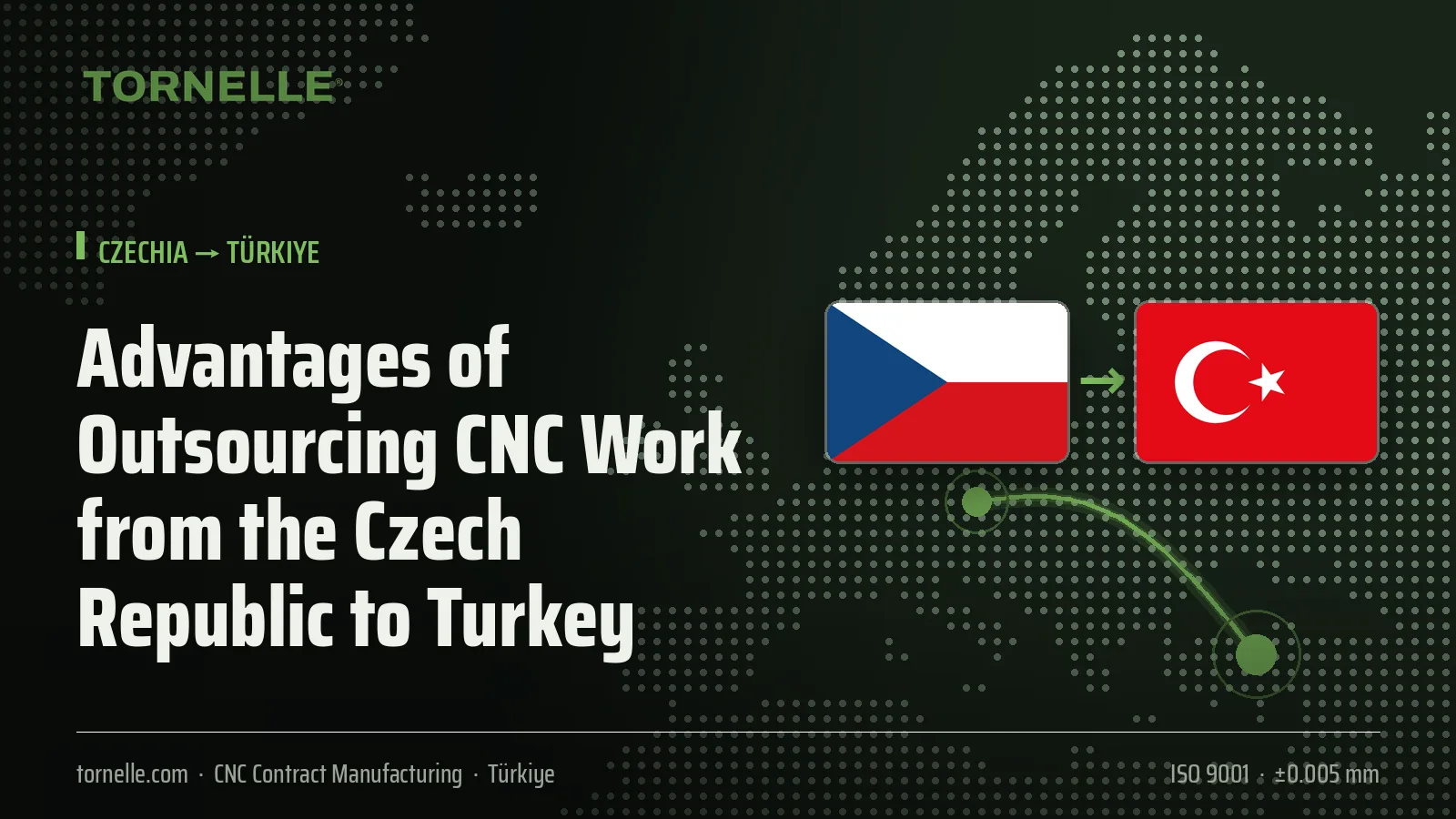
The Czech Republic is one of Europe’s leading countries in per capita industrial production: automotive (Škoda and numerous Tier-1/Tier-2 suppliers), machine tools, agricultural and construction machinery, aerospace, and energy equipment. The cost of this intensive industrial structure is one of Europe’s lowest unemployment rates for years—and the resulting shortage of skilled workers. As it becomes increasingly difficult to find lathe operators and millers, Czech manufacturers are outsourcing standard machining jobs and reserving their own machine tools for critical parts. In this article, we discuss the advantages of CNC contract manufacturing in Turkey for Czech buyers.
1. Capacity to Address the Skilled Labor Shortage
The problem for CNC workshops in the Czech Republic is not demand, but finding operators to man the machines. In Turkey, however, machining benefits from a strong labor base supported by vocational high schools and a broad supporting industrial ecosystem. The concentration of workshops in Istanbul, Bursa, Konya, and Izmir can quickly provide the additional capacity that Czech manufacturers need. At Tornelle, mass production capacity is allocated according to annual call-off plans.
2. Cost: A Narrowing but Significant Gap
The Czech Republic is no longer a low-cost country; industrial wages have risen rapidly over the past decade, and energy costs have approached those of Germany. While hourly rates for 3-axis lathes and mills in Turkey remain in the 28–45 € range, they have approached the 35–55 € level in the Czech Republic. For labor-intensive parts, savings of 15–30%—including shipping—are realistic. Although the difference isn’t as dramatic as with Germany, when combined with capacity assurance, it’s sufficient to justify the decision. For the calculation method, please refer to our article on cost comparisons.
3. Customs Union and A.TR
The Czech Republic is an EU member. Industrial products shipped from Turkey enter duty-free and quota-free with an A.TR movement certificate; there are no rules of origin. The buyer pays only the deductible import VAT (21%). Since the Czech Republic is not in the Eurozone, Turkish suppliers provide quotes in Euros; the CZK/EUR exchange rate risk is managed according to the buyer’s own financial policy.
4. Logistics: 3–4 Days to the Heart of Central Europe
Road transport between Istanbul and Prague or Istanbul and Brno, via the Bulgaria–Serbia–Hungary–Slovakia route, typically takes 3–4 business days. The heavy TIR traffic between Turkey and Central Europe ensures frequent departures and competitive freight rates for less-than-truckload (LTL) shipments. For urgent shipments, air freight takes 1–2 days. See our logistics guide for details.
5. Automotive Quality and Certification Practices
The automotive industry is the backbone of the Czech industrial sector, and suppliers are expected to provide PPAP, FAI, material certificates, and statistical process control. Since Turkey is also one of Europe’s major automotive manufacturers, this certification culture is well-established in the Turkish automotive supply chain. It is sufficient to clarify which documents are required in the quality agreement; you can find a checklist in our quality assurance article.
6. Industry Compliance
- Automotive: Turned shafts, bushings, fasteners, aluminum housings, brass and free-cutting steel Swiss-type turned parts.
- Machine Tool and Machinery Manufacturing: Alloy steel shafts, gear housings, slide components, hydraulic blocks.
- Agricultural and construction machinery: Heavy-duty turned parts, pins, bushings, hydraulic cylinder components.
- Energy and aerospace: Precision parts made of stainless and alloy steel, with full traceability.
7. Contact and Standards
There is a 1-hour time difference between Turkey and the Czech Republic; technical inquiries are answered the same day. Czech ČSN EN standards are identical to EN/ISO standards; no additional conversions are required for drawings. Technical communication in English and German is standard practice in export-oriented Turkish workshops.
Points to Consider
- Compare quotes using the same delivery terms (e.g., DAP Prague).
- Specify in the contract that the A.TR certificate must accompany the shipment.
- Specify the PPAP level and number of samples for automotive parts in the order.
- Keeping critical know-how components in-house while outsourcing standard parts is a sound strategy frequently employed by Czech manufacturers.
Frequently Asked Questions
Isn’t the Czech Republic’s own CNC sector strong?
It is very strong; the issue is capacity and labor. Turkey enables Czech manufacturers to outsource standard parts, allowing them to dedicate their own machinery to critical tasks.
What is the lead time?
3–4 business days by road; 3–6 weeks total including production. For urgent orders, air freight takes 1–2 days.
Are customs duties payable?
No. Industrial products are duty-free with an A.TR certificate; only the deductible import VAT is paid.
Can prices be quoted in CZK?
Turkish exporters provide quotes in euros; a CZK equivalent is included as a reference upon request.
Conclusion
For Czech manufacturers, Turkey is a duty-free, automotive-grade contract manufacturing source located just 3–4 days away—a solution to labor shortages and full production capacity. Send the technical drawings of the parts you’re considering outsourcing via our quote form; you’ll receive a competitive quote within 24 hours.