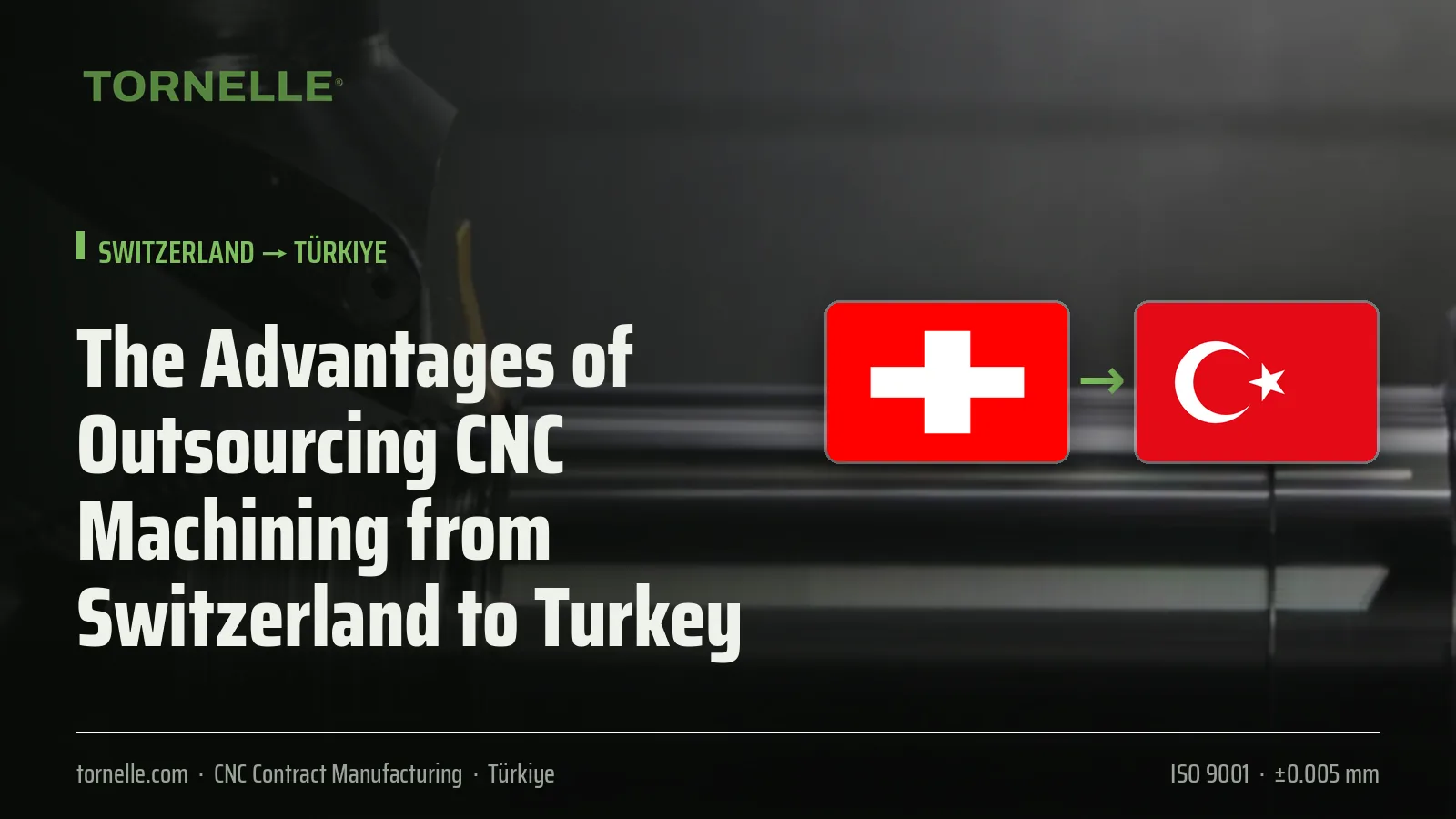
For Swiss industry, there is no such thing as “good enough”; every part—from medical implants to watch movements, and from precision measuring devices to machine components—is expected to be manufactured with micron-level precision and accompanied by comprehensive documentation. At the same time, the industry grapples with the world’s highest labor costs and the pressure on exports caused by the strong Swiss franc. This dilemma drives Swiss companies to seek suppliers that can reduce costs without compromising on quality. Turkey stands out as a leading option in this search.
1. EFTA–Turkey Free Trade Agreement
Since Switzerland is not an EU member, the Customs Union does not apply; however, thanks to the Free Trade Agreement between EFTA (Switzerland, Norway, Iceland, Liechtenstein) and Turkey, industrial products of Turkish origin enter Switzerland duty-free with an EUR.1 movement certificate or an invoice declaration. Switzerland has also unilaterally eliminated customs duties on industrial products effective 2024; therefore, in practice, there is no customs duty burden on metal parts. Only Swiss VAT (MWST, 8.1%) is declared on imports and is offset by regular importers.
2. Precision Machining and Swiss-Type Automatic Lathe Experience
“Décolletage”—the production of small, precision parts using Swiss-type automatic lathes—is at the heart of the Swiss market and has found a strong counterpart in Turkey. Export-oriented Turkish suppliers:
- produce Swiss-type automatic lathe parts with tolerances of ±0.005 mm and tighter within the Ø0.5–32 mm range;
- Have experience with stainless steel (1.4404, 1.4441 implant-grade), titanium (Grade 5), brass, and automatic lathe steel;
- Achieve surface roughness of Ra 0.2 µm or less through grinding and polishing;
- Offers a 100% inspection option with CMM and optical measurement reports;
- Understands the ISO 13485 framework and cleaning/packaging requirements for the medical industry;
3. Cost: The Swiss Franc Advantage
The hourly cost of CNC machining in Switzerland is the highest in Europe; the Swiss franc is structurally strong against the euro and the dollar. While production costs in Turkey are significantly lower, the franc’s purchasing power provides an additional advantage for Swiss buyers. Result: Typically a 40–55% total cost advantage at the same quality level—especially for labor-intensive precision parts. Calculation logic: Germany–Turkey comparison; the difference is even greater for Switzerland.
4. Delivery Time
The road distance from Istanbul to Zurich/Basel is approximately 2,300 km; delivery takes 4–6 business days via regular routes. Since Swiss customs is outside the EU, customs declaration is required at the border; experienced freight forwarders handle this as a routine procedure. Air freight from Istanbul to Zurich/Geneva takes 1–2 days. Compared to a 6–8-week lead time from Asia, inventory requirements are significantly reduced.
5. Standards and Documentation
Swiss technical drawings are based on SN EN ISO standards (ISO 2768, ISO 1101, ISO 1302 surface designations); the same notation used in the German and European markets is directly readable by Turkish suppliers. Technical communication in German is possible for regions where Swiss German is spoken; English is the standard. The EN 10204 3.1 material certificate, initial sample report (EMPB / FAI), and traceability requirements are met. See the quality assurance guide.
6. Industry Compliance
- Medical technology: Implant screws, surgical instrument components, dental parts—stainless steel and titanium.
- Machinery and automation: Precision shafts, bushings, housings.
- Measurement and optical devices: Aluminum and brass micro-parts.
- Fasteners and connectors: High-volume sliding automatic machine parts.
- Watch and jewelry supply industry: Fixtures, tools, and mechanical components.
7. Time Zone and Transportation
Turkey is 1 hour ahead of Switzerland. The flight from Zurich to Istanbul takes approximately 3 hours, and there are numerous direct flights daily. Supplier audits can be conducted in a single-day visit; virtual factory tours and digital audits are also common.
Practical Notes for Swiss Buyers
- Request an EUR.1 certificate or invoice declaration in the shipping documents; this ensures duty-free entry under preferential origin rules.
- Request 100% inspection or an SPC report for critical parts; specify this in the RFQ.
- Prefer FCA Istanbul or DAP as Incoterms; DDP is rare because it requires VAT registration in Switzerland.
- Pricing in CHF or EUR is possible; agree on an exchange rate band in the long-term contract.
Frequently Asked Questions
Are there customs duties on imports from Turkey to Switzerland?
Under the EFTA–Turkey Free Trade Agreement (FTA), industrial products of Turkish origin are exempt from customs duties with an EUR.1 certificate or an invoice declaration; additionally, Switzerland has eliminated customs duties on industrial products as of 2024. Only MWST is declared.
Is Turkey a suitable source for medical components?
Yes. ISO 13485-certified suppliers have experience in processing implant-grade stainless steel and titanium, and full traceability is available.
Is a tolerance of ±0.005 mm possible?
Yes. Tolerances of ±0.005 mm and tighter are produced using sliding automatic machines and precision grinding, and are documented with a CMM report.
What is the lead time?
1–2 weeks for prototypes, 3–6 weeks for mass production; 4–6 business days by road to Switzerland, 1–2 days by air freight.
Conclusion
When Switzerland’s expectations for precision are combined with Turkey’s cost and capacity advantages, a strong supply equation emerges: duty-free trade, micron-level precision, complete documentation, and significant savings in Swiss francs. Send us your technical drawings and receive a quote within 24 hours.