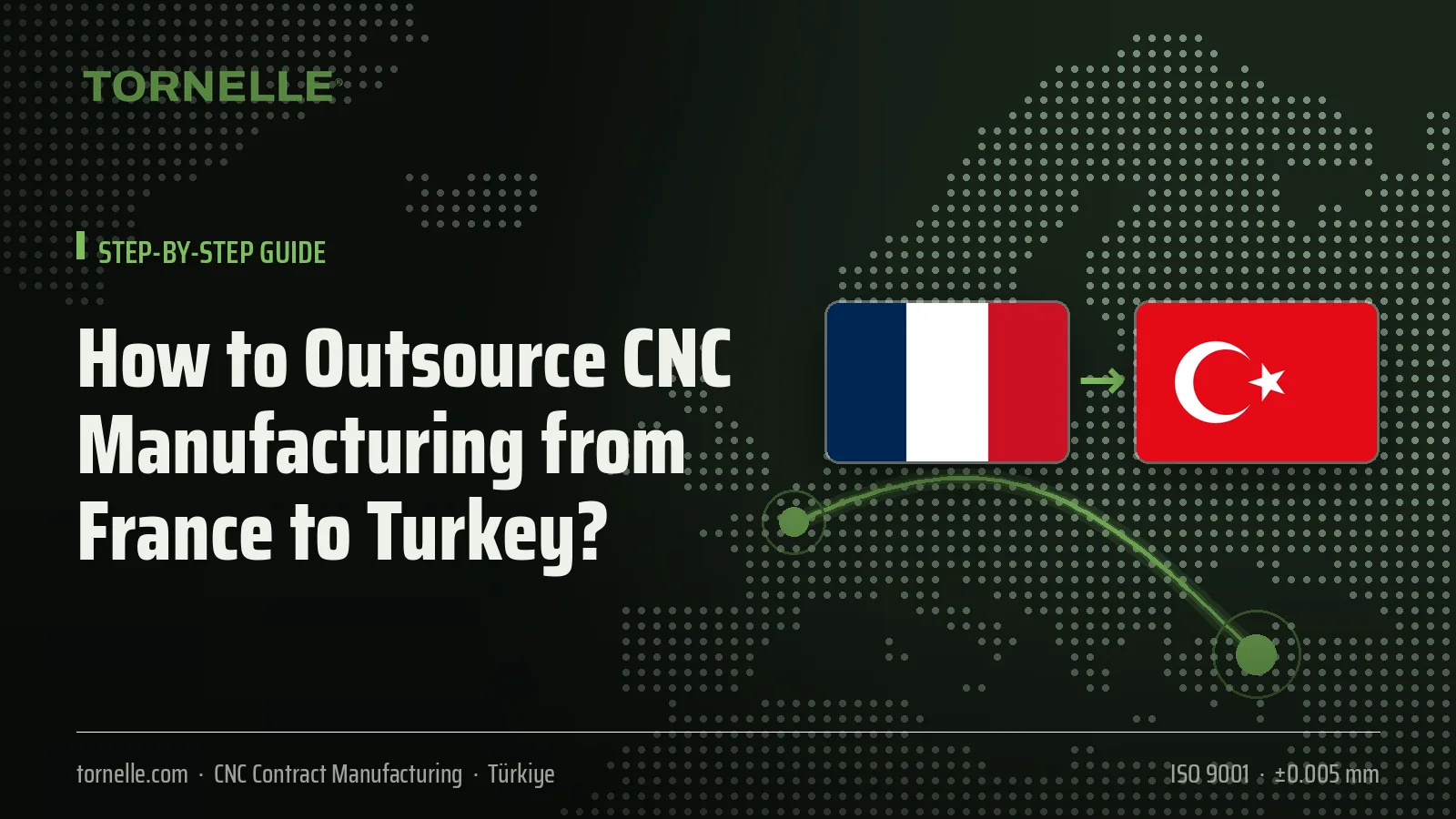
After evaluating the advantages of outsourcing CNC work from France to Turkey, this guide explains step by step how to carry out the process in practice. The approach follows the sequence familiar to French procurement practices: consultation, devis, échantillonnage, validation, série.
Step 1: Prepare the Technical Specifications
- Drawing (PDF): Compliant with the NF EN ISO standard; general tolerance class (ISO 2768-mK), critical dimensions, surface finish (Ra), edge rounding, threads. May remain in French.
- 3D model (STEP): Required for pricing and CAM.
- Material: EN designation (X2CrNiMo17-12-2 / 1.4404, 42CrMo4, EN AW-6082 T6) and certificate type (EN 10204 3.1).
- Surface and heat treatment: Anodizing, passivation, zinc-nickel plating, hardening (depth and HRC).
- Quantity and scheduling: Annual forecast, lot size, first delivery date.
Detailed checklist: RFQ preparation guide.
Step 2: Request a Quote
Export-focused Turkish suppliers will provide a quote within 1–3 business days. The quote should include quantity tiers, setup costs, the scope of certificates and reports, delivery time, and Incoterms. Good suppliers also include design-for-manufacturing (DFM) recommendations. Compare quotes based on total cost of ownership (TCO): include shipping, customs brokerage, payment terms, and inventory costs.
Step 3: Commercial Terms
Incoterms
Typical options for French buyers are FCA Istanbul (your own freight forwarder handles transport) or DAP (the supplier delivers to your factory). In both cases, the import declaration and VAT remain the responsibility of the French party.
Payment
For the first order, a 30–50% advance payment, with the balance due before shipment; for ongoing relationships, 30–60 days’ credit terms. Euro-based pricing is standard; there is no exchange rate risk.
Contracts
A confidentiality agreement (accord de confidentialité) is recommended prior to sharing technical data, along with a quality agreement for serial supply and a framework agreement (contrat cadre).
Step 4: Sample and Approval
Obtain a sample or pilot batch prior to series production. Request a measurement report (CMM protocol for critical dimensions), an EN 10204 3.1 certificate, and, if necessary, a surface treatment certificate along with the sample. FAI (EN 9102) for aerospace and PPAP format for automotive may be specified. We have compiled the quality steps in our quality assurance guide.
Step 5: Customs and VAT
The import of industrial products from Turkey to France is exempt from customs duties under the Customs Union with an A.TR certificate. Required documents:
- EORI number (starting with FR) — you, as the importer, must have this.
- Commercial invoice — HS code, Incoterms, value.
- A.TR movement certificate — issued by the Turkish exporter and endorsed by customs.
- Packing list and CMR (road transport) or AWB (air transport).
- Import declaration — submitted via the DELTA system by your freight forwarder or customs broker.
VAT: As of January 1, 2022, import VAT in France is no longer paid at customs due to mandatory reverse charge; it is declared on the CA3 declaration and offset simultaneously. There is no cash outflow.
Step 6: Serial Delivery
- Framework agreement + call-off order: The annual quantity is fixed, and orders are placed via monthly deliveries.
- Safety stock: 2–4 weeks’ inventory held by the supplier; since road transport takes 4–6 days, the effective lead time is reduced.
- Consolidated shipment: Combine multiple part numbers into a single shipment.
Shipping options: logistics guide.
Common Mistakes
- Forgetting to request the A.TR certificate along with the invoice;
- Setting tolerances too narrowly;
- Failing to document acceptance criteria;
- Failing to share the annual forecast;
- Skipping the sampling phase.
Frequently Asked Questions
Can I submit technical drawings in French?
Yes. The notation is based on European standards; technical communication is conducted in English.
Do I need to pay import VAT in advance?
No. In France, import VAT is declared via mandatory self-assessment and offset on the same tax return.
How long does the first order take?
For samples: 1–2 weeks production + 2–6 days shipping; for production runs: 3–6 weeks production + 4–6 days by road.
How are complaints handled?
Through the 8D process outlined in the quality agreement; thanks to our proximity, replacement parts are provided within a few days.
Conclusion
Outsourcing CNC machining from France to Turkey is a process that operates just like intra-European sourcing—provided you have the correct technical files, clear Incoterms, and an A.TR certificate. Send us your plans and receive a quote and a manufacturing feasibility assessment within 24 hours.