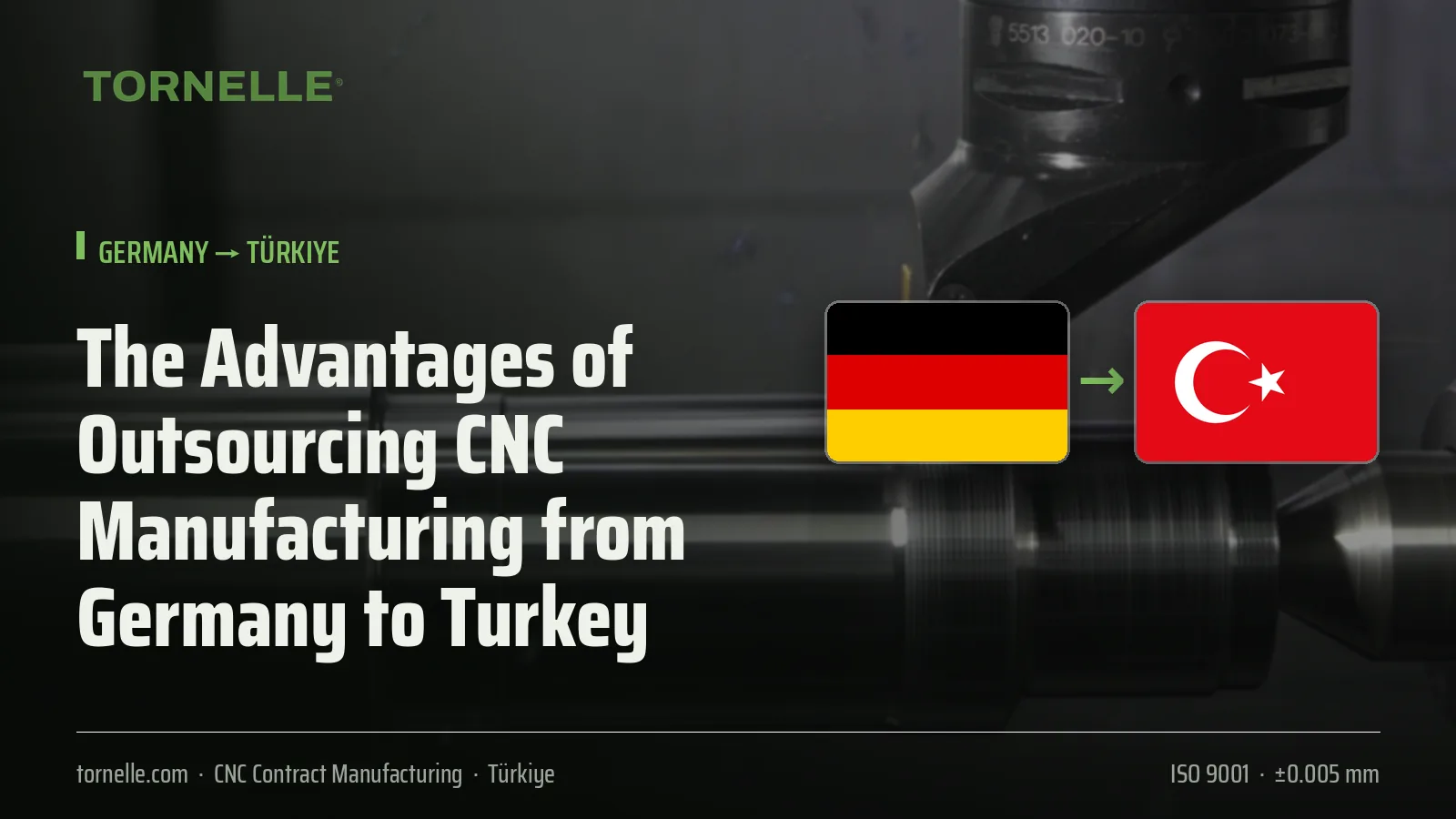
For decades, the German machinery and automotive industries have upheld “Made in Germany” quality through their local supplier network. However, rising energy costs, a shortage of skilled labor (Fachkräftemangel), and price pressures are driving Mittelstand companies—particularly small and medium-sized enterprises (SMEs)—to seek alternative sources for turned and milled parts. In this search, Turkey occupies a unique position for German buyers compared to all other low-cost countries: it is duty-free, geographically close, and familiar with German work culture.
1. Customs Union: Zero Customs Duties, Simple Process
Thanks to the EU–Turkey Customs Union, which has been in effect since 1996, industrial products manufactured in Turkey enter Germany duty-free with an A.TR movement certificate. There are no customs duties (typically 2.7%–4.7% on metal parts), no risk of anti-dumping investigations, and no lengthy customs clearance times, as is often the case with imports from China. The German importer simply declares the Einfuhrumsatzsteuer (import VAT) and offsets it on their tax return. We have detailed this process in our article on the Customs Union and A.TR.
2. Delivery via Road in 4–6 Business Days
The distance between Istanbul and Munich is approximately 2,300 km, and between Istanbul and Stuttgart, approximately 2,500 km. Using regular road transport routes, parts reach the door of your German factory within 4–6 business days; air freight is available for urgent situations, reducing delivery time to 1–2 days. Compared to 6–8-week sea freight delivery from the Far East, this significantly reduces safety stock and shortens the lead time for engineering changes to be reflected in mass production. For detailed logistics information, please refer to our logistics guide.
3. Proficiency in DIN, ISO, and German Technical Drawing Standards
The Turkish machining sector has been shaped by over 40 years of supply relationships with the German automotive and machinery industries. As a result, export-oriented Turkish CNC shops:
- directly interpret the general tolerances of DIN ISO 2768, the geometric tolerances of ISO 1101, and German technical drawing notation (e.g., “allgemeine Toleranzen,” “Kanten gebrochen,” “Oberflächenangaben”);
- are familiar with German material designations (1.4301, 1.4404, 42CrMo4, 11SMnPb30, EN AW-6082) and source raw materials accordingly;
- Is familiar with the standard expectations of German buyers, such as the EN 10204 3.1 material certificate, the Erstmusterprüfbericht (initial sample test report), and measurement reports;
- Can communicate technically in German for the most part.
In this article, we have discussed in greater detail why Germany views Turkey as a new manufacturing hub.
4. Cost Advantage: Same Quality, Lower Total Cost
While the hourly rate for a CNC lathe in Germany (including the operator) typically ranges from 65 to 95 €, this cost is significantly lower in Turkey. Since raw material prices are global, the difference in material costs is minimal; the main savings come from processing time, setup time (Rüstzeit), and overhead costs. In practice, German buyers typically see a 30–45% total cost advantage for multi-operation parts with tight tolerances; for simple, material-intensive parts, this percentage is lower. For a numerical example, review our Germany–Turkey cost comparison.
5. Capacity and Flexibility
Capacity constraints among German suppliers—particularly long lead times for small and medium-sized production runs—are less pronounced in Turkey. Turkish workshops operate across a wide range, from pilot batches of 50 units to annual call-off orders of 100,000 units; a fleet of sliding automatic lathes provides flexibility for high-volume small parts, while 5-axis machining centers handle complex housings.
6. Same Working Hours, Easy Visits
There is only a 1-hour time difference (1 hour during daylight saving time) between Turkey and Germany. Dozens of direct flights daily from Frankfurt, Munich, or Düsseldorf to Istanbul—with a flight time of just 3 hours—turn supplier audits into one-day business trips. This is significantly less expensive than visiting a supplier in Asia just once a year.
7. Supply Chain Resilience
The pandemic and subsequent freight crises highlighted the risks of relying on a single source or distant suppliers. Adding Turkey as a second source (dual sourcing) provides German companies with both price competitiveness and supply security. Land-based supply is not affected by disruptions in the Suez Canal or shocks in the container market.
Practical Recommendations for German Buyers
- You can leave technical drawings in German; however, listing critical dimensions and acceptance criteria on a separate page reduces friction.
- Request an Erstmusterprüfbericht and a 3.1 certificate with the first order; this quickly demonstrates the supplier’s process maturity.
- Establish a framework agreement (Rahmenvertrag) and call-off order (Abrufauftrag) structure by sharing annual volume estimates; this improves unit pricing and raw material planning.
- Select FCA Istanbul or DAP factory as the Incoterms; this clarifies shipping responsibility.
Frequently Asked Questions
Is a customs declaration required for parts coming from Turkey?
Yes, since Turkey is not an EU member, an import declaration is required; however, thanks to the A.TR certificate, customs duties are zero, and the process is routinely handled by the freight forwarder or customs broker.
Are German material standards available in Turkey?
Yes. Grades 1.4301, 1.4571, 42CrMo4, C45, 11SMnPb30, CuZn39Pb3, and EN AW aluminum alloys are commonly stocked in Turkey; certified materials of European origin can also be sourced.
Is there a minimum order quantity for small Mittelstand companies?
Generally, no; prototypes and runs of 10–100 pieces are also produced. The impact of setup costs on the unit price is transparently shown in the quote.
How do I start outsourcing work to Turkey?
We’ve outlined the step-by-step process in our article titled “How to Outsource CNC Machining from Germany to Turkey.”
Conclusion
Outsourcing CNC work from Germany to Turkey is not merely “sourcing from a low-cost country,” but rather a near-sourcing strategy that meets European standards. Duty-free trade, delivery in less than a week, DIN/ISO compliance, and competitive costs are all offered in a single package. Submit your technical drawings via our quote form; receive a response regarding pricing and manufacturability within 24 hours.