Blog
Technical insights, industry news and engineering tips from the world of CNC machining.
Turkey for Aerospace and Defence Parts: Ecosystem, Expectations and Contract Sourcing
Turkey has made a major leap in aerospace and defence over the last decade; this growth brought tight-tolerance aluminium, titanium and stainless machining capacity and an AS9100 culture with it. This article draws a realistic picture for European aerospace and defence supply managers: the structure of the ecosystem, the AS9100, special-process and traceability expectations, typical part groups and the matching supplier profile, export controls and confidentiality, realistic expectations, and where a non-certified precision shop like TORNELLE fits.
Aerospace Read more
Turkey's Machining Industry: Figures, Capacity and Regions
When a European purchaser adds Turkey to the sourcing list, the first question is: how large is this country's machining capacity really? Drawing on public data and industry observation, this article describes the order of magnitude of Turkey's machining industry, the structure of the machine park, the regional clusters from Istanbul to Konya, the workforce and training base, the SME-dominated structure of subcontracting capacity, its limits and risks, and what all this means in practice for a European buyer.
Turkey Read more
Small Workshop or Large Factory? Choosing the Right CNC Supplier Size in Turkey
Turkey's CNC contract manufacturing ecosystem ranges from 5-machine family workshops to 200-machine automotive suppliers. Which size is right for you? This article compares small and large suppliers through the eyes of a purchaser placing work from abroad across eight dimensions — price, flexibility, quality-system maturity, capacity and dependency risk, communication, technology breadth, certification and financial resilience — shows the problems caused by size mismatch, offers a decision matrix by part profile and explains how to verify fit with a remote audit.
Decision Read more
Quenched and Tempered Steels (42CrMo4, C45): CNC Machining and Heat Treatment Guide
The most widely used steel group for shafts, pins, gear blanks, bolts and hydraulic components is the quenched and tempered steels: C45, 42CrMo4, 34CrNiMo6, 25CrMo4. This article explains from the contract-manufacturing perspective in which delivery condition to buy the material, how machinability changes, when to harden before or after machining, how to manage distortion and grinding allowances, which surface-hardening options exist and what to demand in material certificates and heat-treatment reports.
Material Read more
Shipping CNC Parts from Turkey to the UK: Post-Brexit Customs Guide
Brexit changed the legal basis of Turkey–UK trade when the UK left the EU Customs Union; the A.TR certificate is no longer valid on this route. In its place, the Turkey–United Kingdom Free Trade Agreement in force since 2021 keeps industrial goods duty-free with an origin declaration. This guide explains for British buyers the tariff code and UK Global Tariff, import VAT via Postponed VAT Accounting, GB EORI and CDS declarations, Incoterm choice, logistics options and transit times, the Northern Ireland exception, common mistakes and a worked example shipment.
Customs Read more
Done-in-One Machining on Mill-Turn Centres: When Does It Make Sense?
Machining a part first on a lathe and then on a mill means two set-ups, two programmes, two waits and two sources of error. Mill-turn centres and CNC lathes with live tooling reduce this chain to a single set-up. This article explains from the contract-manufacturing perspective which parts benefit, what single-set-up machining gains in geometric accuracy, lead time and cost, where the technology reaches its limits, what to ask the supplier at quotation stage and how the designer can make the part more suitable.
Technical Read more
CNC Part Cost Comparison: Scandinavian Countries vs Turkey
The Scandinavian countries are the region with the highest labour costs in Europe; CNC hourly rates run in the 80–110 € band. This article compares CNC part costs between Sweden, Denmark, Norway and Finland and Turkey item by item: machine hourly rate, labour and social charges, energy, raw material, tooling, freight and customs. Two worked examples (a stainless flange and an aluminium housing) show the real difference, the total-cost-of-ownership calculation is explained, and the cases where Turkey does not make sense are listed.
Cost Read more
Sourcing Turned Parts from Turkey for the German Automotive Supply Industry
While the German automotive supply industry is squeezed between cost pressure, electrification and supply-chain diversification, Turkey has become a logical nearshoring address for turned parts. This article explains what Tier-1 and Tier-2 buyers look at when sourcing turned parts from Turkey, how VDA 6.3 and PPF/PPAP expectations are met on the contract shop's side, which part families are suitable, the role of Swiss-type turning, Bursa–Germany logistics and realistic price ranges.
Automotive Read more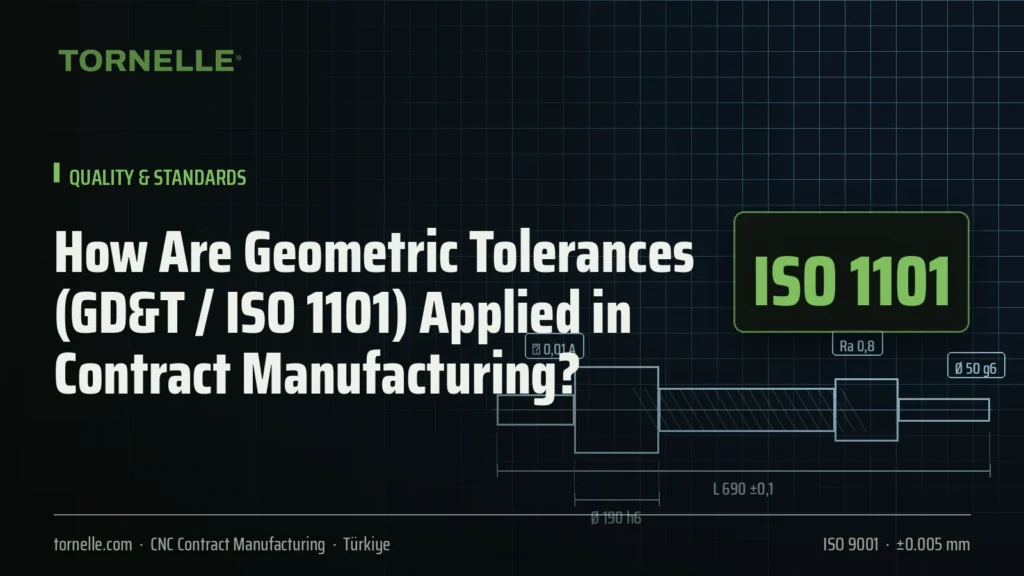
How Are Geometric Tolerances (GD&T / ISO 1101) Applied in Contract Manufacturing?
A position tolerance frame on a drawing says far more than a dimensional tolerance: which surface the part is referenced from, which measuring method is required and therefore what it will cost. This article explains the practical meaning of GD&T (ASME Y14.5) and ISO GPS (ISO 1101) in contract manufacturing: the most common geometric tolerances, datum logic, material condition (MMC/LMC) and bonus tolerance, which measuring equipment verifies each tolerance, the mistakes made when sending drawings to a supplier, and the relationship with cost.
Quality Read more