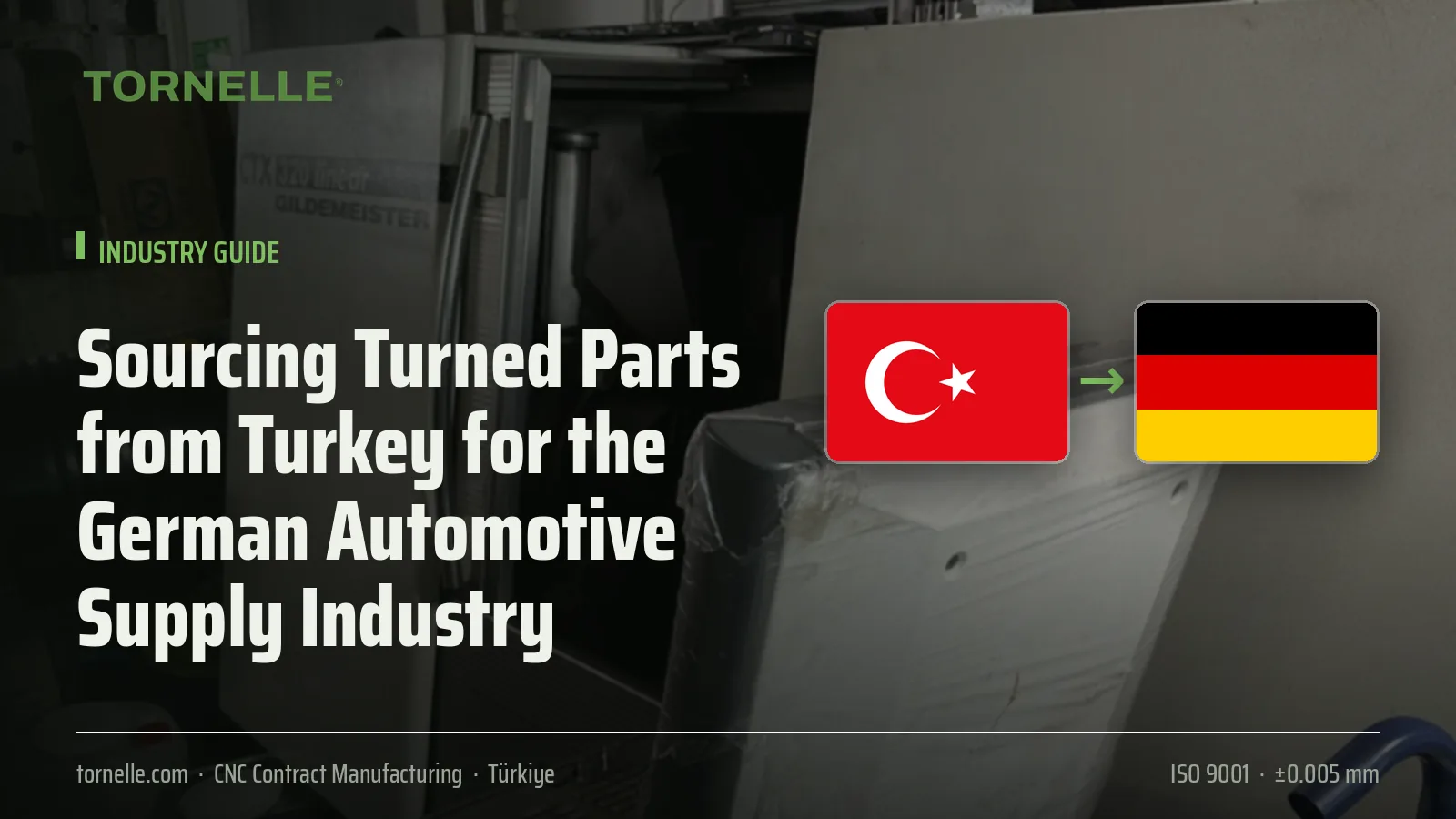
For the automotive supply industry (Zulieferindustrie) in Germany, sourcing turned parts has been under three pressures in recent years: OEMs' annual price-reduction demands, a part portfolio changing with electrification and the wish to reduce dependence on Asia. Our article on Turkey for automotive suppliers drew the general picture; this one focuses specifically on the purchase of turned parts (Drehteile) by German Tier-1/Tier-2 companies.
Why Does Turkey Fit the German Automotive Supply Chain?
- Existing integration: Turkey is part of European automotive production; German OEMs and Tier-1s have plants in Bursa and Kocaeli, with hundreds of supplier shops working for them. Automotive quality culture (IATF 16949, VDA) is established.
- Customs Union: Turned parts enter duty-free with A.TR; there is no origin or preferential-trade issue.
- Logistics: Bursa/Istanbul to Stuttgart or Bavaria in 4–6 working days by road; regular weekly full-load and groupage departures. 5–6 weeks saved versus China, lower inventory carrying cost.
- Cost: 35–50% lower unit prices for turned parts than in Germany; our cost comparison has an itemised calculation.
Which Turned-Part Families Are Suitable?
| Part family | Typical material | Pcs/year | Suitable technology |
|---|---|---|---|
| Connection nipples, unions, hydraulic fittings | 11SMnPb30, 1.4305, CuZn39Pb3 | 50,000–2,000,000 | Swiss-type turning |
| Sensor housings, connector pins | Brass, aluminium, stainless | 100,000+ | Swiss-type turning |
| Shafts, pins, bushings (Ø 10–60 mm) | C45, 42CrMo4, 16MnCr5 | 5,000–200,000 | CNC turning, mill-turn |
| Flanges, adapters, pump/valve bodies | Aluminium, cast iron, steel | 2,000–50,000 | CNC turning + milling |
| E-mobility busbar connections, cooling unions | Copper, aluminium | 10,000–500,000 | Swiss-type, mill-turn |
For high-volume small-diameter parts, Swiss-type turning is decisive: finished parts from bar in a single cycle, short cycle times and consistent quality. The economics of the technology are explained in our article on series production with Swiss-type lathes.
What the German Automotive Buyer Expects
Quality system
Tier-1s generally require IATF 16949 from their direct suppliers; at Tier-2/Tier-3 level, ISO 9001 plus command of the automotive tools (PPF, FMEA, control plan, MSA, SPC) is usually sufficient. At quotation stage the supplier must state clearly which certificate it holds and which tools it applies; the certificate claim must be verifiable. Our ISO 9001 article explains the difference between certificate and practice.
Sample approval: PPF / PPAP
Production process and product approval (PPF) according to VDA 2 or AIAG PPAP level 3 is the typical request: dimensional report, material certificate, process flow chart, control plan, MSA, initial capability data (Cmk ≥ 1.67). Our PPAP article details what can be expected from a contract shop.
Supplier audit
VDA 6.3 process audit or a customer-specific questionnaire; remote (video) pre-audits have become common. Turkish suppliers are used to these audits; the document package (organisation chart, calibration list, training matrix, traceability flow) must be ready before the audit.
Logistics and packaging
KLT containers (VDA 4500), labelling (VDA 4902 / GTL), call-offs (Lieferabruf) via EDI or portal, and JIT/consignment expectations. The Turkish supplier either delivers in KLT itself or works through a consolidation warehouse in Germany.
Price Reality
Example: a hydraulic nipple Ø12×35 mm in 11SMnPb30 steel, threaded and grooved, 300,000 pieces per year. Swiss-type unit price in Germany typically 0.55–0.80 €; in Turkey 0.30–0.45 €. With freight and packaging added, the gap remains around 35–45%. But note: in German automotive, annual price reductions (2–3%) and raw-material indexing are part of the contract; the Turkish supplier must know this from the start and build its quote accordingly.
Risks and How to Manage Them
- Capacity fluctuation: Risk of single-customer dependence in small shops; managed with annual forecast sharing and a frame contract.
- Currency: Euro-based quotes and raw-material indexing largely fix the exchange-rate risk.
- Missing certificate: A shop without IATF 16949 positions itself as Tier-2, not as a direct Tier-1 supplier; this must be stated openly.
- Traceability: Lot-based material-to-batch matching is mandatory in automotive; the system should be queried at quotation stage.
Shipping to Germany and Document Flow
In Tier-1 and Tier-2 supply, documents must arrive on time as much as parts. Typical flow: for each batch the Turkish supplier prepares the delivery note, commercial invoice, A.TR movement certificate, packing list and, per customer specification, the inspection report and material certificate; documents are shared electronically before dispatch, originals travel with the truck. Road transport Istanbul–Stuttgart/Munich takes 3–5 working days, Northern Germany 4–6. Customs duty is zero with A.TR; import VAT is deducted as input tax in the German company's return. Labelling follows VDA 4902 or the customer's label template; KLT containers are supplied by the customer or equivalent one-way packaging is used. Process details are in our logistics article.
A Practical Roadmap to Get Started
- Select 3–5 representative parts from the family; record annual volume and current price.
- State the PPF level, control plan and inspection report expectations in the RFQ.
- See the machine park and measuring room in a remote video audit.
- Approve first samples and process capability with a pilot batch (100–500 pieces).
- Move to series supply with a 6–12-month frame agreement and monthly call-offs; keep the second source during the first year.
Frequently Asked Questions
Is IATF 16949 mandatory for Tier-2?
It depends on the customer. Many Tier-1s require ISO 9001 plus application of the automotive tools from their sub-suppliers; they count IATF as a preference but do not make it a condition. Check your own customer's supplier manual before quoting.
How long does PPF/PPAP preparation take?
Typically 3–5 weeks including sample production and full measurement; a pre-series of at least 50 parts is needed for the Cmk study.
Are KLT and VDA labels mandatory?
It depends on the Tier-1's logistics specification. Turkish suppliers can work with KLT; label format and container type should be clarified in the quote.
What is the delivery time to Germany?
4–6 working days by road; for series supply a fixed weekly schedule is set up. Details in our Germany shipping article.
As a Tier-2, can I count a part bought from a Turkish supplier as EU origin towards the German OEM?
Origin depends on the nature and added value of the processing in your own plant; repackaging alone does not confer origin. Free circulation within the Customs Union (A.TR) and preferential origin (EUR.1) are different concepts; assess part by part with your customs broker.
Is a Turkish supplier ready for a VDA 6.3 audit?
IATF-certified medium and large suppliers are used to VDA 6.3 process audits; ISO 9001 shops should be allowed preparation time before the audit. Sharing the audit scope in the RFQ helps you select the right supplier profile.
Conclusion
For the German automotive supply industry, sourcing turned parts from Turkey is a realistic nearshoring option supported by the Customs Union, 4–6-day logistics, an established automotive quality culture and Swiss-type capacity. Send your part drawings, annual volumes and quality requirements (PPF level, packaging specification) via our quote form; we quote in euros and state our capacity and certificate status openly.