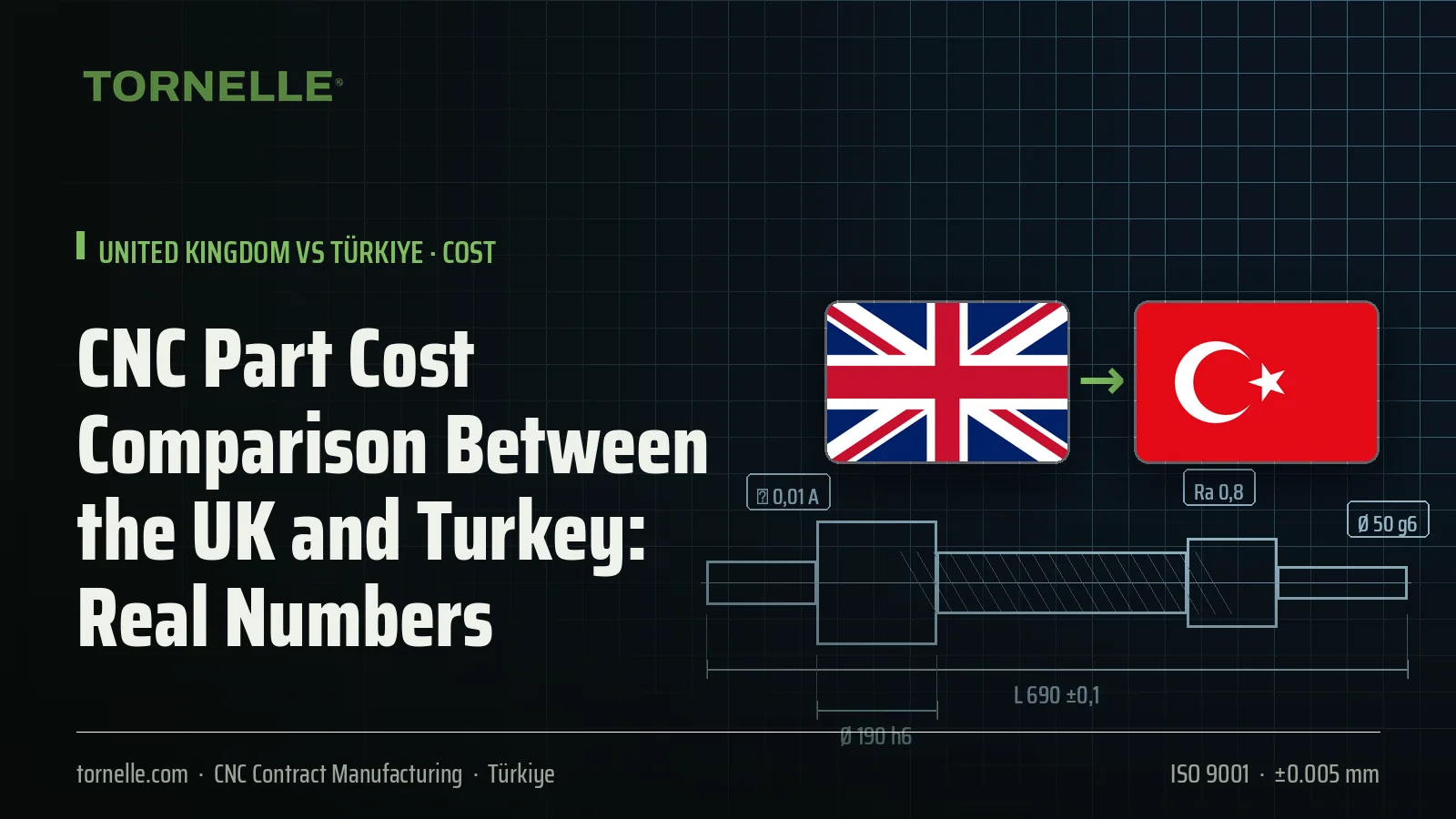
For buyers in the United Kingdom, the sourcing equation changed after 2021: parts from the EU now also require a customs declaration, an EORI number and import VAT. Thanks to the free trade agreement between Turkey and the United Kingdom (2021), CNC parts of Turkish origin enter duty-free; in customs terms Turkey is therefore on a par with an EU supplier, and in cost terms clearly ahead. This article is the UK version of our Germany comparison and adds numbers to our advantages and process articles. The figures are typical values reflecting 2025–2026 market conditions; they vary by supplier and part.
Line-by-Line Comparison
| Item | United Kingdom | Turkey | Difference |
|---|---|---|---|
| CNC turning hourly rate (3-axis) | £50–70 (≈ €58–82) | €28–40 | ≈ 45–50% lower |
| CNC milling hourly rate (3-axis) | £55–75 (≈ €64–88) | €30–45 | ≈ 45–50% lower |
| 5-axis milling hourly rate | £75–110 (≈ €88–128) | €45–65 | ≈ 45–50% lower |
| Swiss-type turning hourly rate | £45–65 (≈ €52–76) | €25–38 | ≈ 50% lower |
| Programming / set-up (hour) | £60–80 | €30–45 | ≈ 50% lower |
| Raw material (steel, aluminium, stainless) | Market (import-heavy) | Market (±5%) | Similar |
| Industrial electricity (kWh) | £0.20–0.28 (among the highest in Europe) | €0.10–0.14 | ≈ 50% lower |
| Coating / heat treatment | Market | 20–35% lower | Medium |
| Freight to the UK (share of part value) | 0.5–1% (domestic) | 3–5% (road, 5–7 days) | Higher for Turkey |
| Customs duty | — | 0% (Turkish origin, with statement on origin) | None |
| Customs declaration (per shipment) | — | £40–80 | Fixed, small; also applies to EU suppliers |
| Import VAT (20%) | Domestic VAT | Offset in the return via PVA; no cash effect | Neutral |
CNC hourly rates in the UK are slightly below Germany's, but energy costs are higher; the difference to Turkey is typically 45–50%. Exchange rate: £1 ≈ €1.15–1.20 is assumed; GBP/EUR movements shift the saving percentage by a few points.
Example 1: Milled Stainless Steel Bracket
1.4404 (316L), 150×60×12 mm plate, 3-axis milling in 2 set-ups, 8 holes, 4 threads, glass bead blasting; ISO 2768-m; quantity 300.
| United Kingdom | Turkey | |
|---|---|---|
| Raw material | £6.20 | £6.40 |
| Machine + labour (16 min) | £17.50 | £8.60 |
| Set-up/programming (per piece) | £1.60 | £0.80 |
| Glass bead blasting | £1.40 | £0.90 |
| Quality/report | £0.80 | £0.60 |
| Overhead + margin | £5.50 | £3.00 |
| Ex-works price | £33.00 | £20.30 |
| Freight + customs declaration | £0.30 | £1.00 |
| Delivered cost | £33.30 | £21.30 |
Saving: ≈ 36%. Because the stainless raw material share is high, the saving is slightly lower than for an aluminium part, but still significant.
Example 2: Turned Free-Cutting Steel Pin
11SMnPb30, Ø10×45 mm, Swiss-type turning, 2 grooves, chamfer, zinc plating; quantity 10,000.
| United Kingdom | Turkey | |
|---|---|---|
| Raw material | £0.09 | £0.09 |
| Swiss-type turning (35 s) | £0.55 | £0.26 |
| Zinc plating (bulk) | £0.08 | £0.05 |
| Set-up/programming | £0.04 | £0.02 |
| Quality (SPC) | £0.03 | £0.02 |
| Overhead + margin | £0.18 | £0.09 |
| Ex-works price | £0.97 | £0.53 |
| Freight + customs declaration | £0.01 | £0.02 |
| Delivered cost | £0.98 | £0.55 |
Saving: ≈ 44%. For high-volume small parts the freight share is negligible; free-cutting steel and Swiss-type turning are among Turkey's strengths.
The Post-Brexit Equation: Comparison with an EU Supplier
For a buyer in the UK, sourcing from the EU (Germany, Poland, Italy) now also requires a customs declaration and proof of origin; for parts that do not meet the rules of origin under the EU–UK agreement, the UK Global Tariff applies (mostly 0–4% on machined metal parts). Under the Turkey–UK agreement, CNC parts of Turkish origin enter at 0% duty with a statement on origin on the invoice. The customs workload is therefore the same as with an EU supplier; the difference is cost and capacity: an ex-works price 10–20% lower than Poland and 40–50% lower than Germany. Details are in our proof of origin article.
Total Cost of Ownership: The Hidden Items
- Inventory and capital: 5–7 days by road requires 1–2 weeks of additional safety stock; at an 8% annual cost of capital, 0.3–0.5% of part value.
- Customs management: Forwarder or customs broker fee of £40–80 per shipment; negligible per part with consolidated monthly shipments.
- Exchange rate: Turkish suppliers quote in EUR (some in GBP); GBP/EUR fluctuation can create ±3–5% volatility for the buyer; an exchange rate rule can be set in the contract.
- Capacity and lead time: Shortage of skilled operators and 8–12 weeks of waiting in the UK; 3–6 weeks in Turkey.
- Quality risk: Equivalent with the right quality system; 1–2 weeks for corrective action in case of a complaint.
Result: for labour-intensive parts, the total cost of ownership saving is typically 30–45%; the method is described in our TCO article.
Where the Saving Remains Low
- Large, simple parts where the raw material share exceeds 60%;
- Very low-quantity (1–5) prototypes, where set-up and freight dominate;
- Parts requiring daily JIT delivery;
- Very high-volume simple parts produced unattended on automated lines in the UK.
Frequently Asked Questions
How much cheaper are CNC parts from Turkey for the United Kingdom?
Typically 30–45% for labour-intensive parts, including freight and customs declaration; 10–20% for material-heavy simple parts.
Is customs duty payable?
Not for parts of Turkish origin; a statement on origin on the invoice is sufficient. Import VAT is offset in the return via PVA.
Can I get a quote in GBP?
Most Turkish suppliers quote in EUR; a GBP-referenced quote and an exchange rate adjustment rule are possible on request.
Can I get numbers for my own part?
Yes. Send your technical drawing with the information in our RFQ guide; you will receive a comparable quote within 24 hours.
Conclusion
The CNC part cost difference between the United Kingdom and Turkey comes from machine hours, labour and energy; thanks to the free trade agreement, customs duty is zero and the post-Brexit customs workload is the same as with an EU supplier. A total saving of 30–45% on labour-intensive parts is a realistic expectation. To see the real numbers for your own parts, send us your technical drawings.