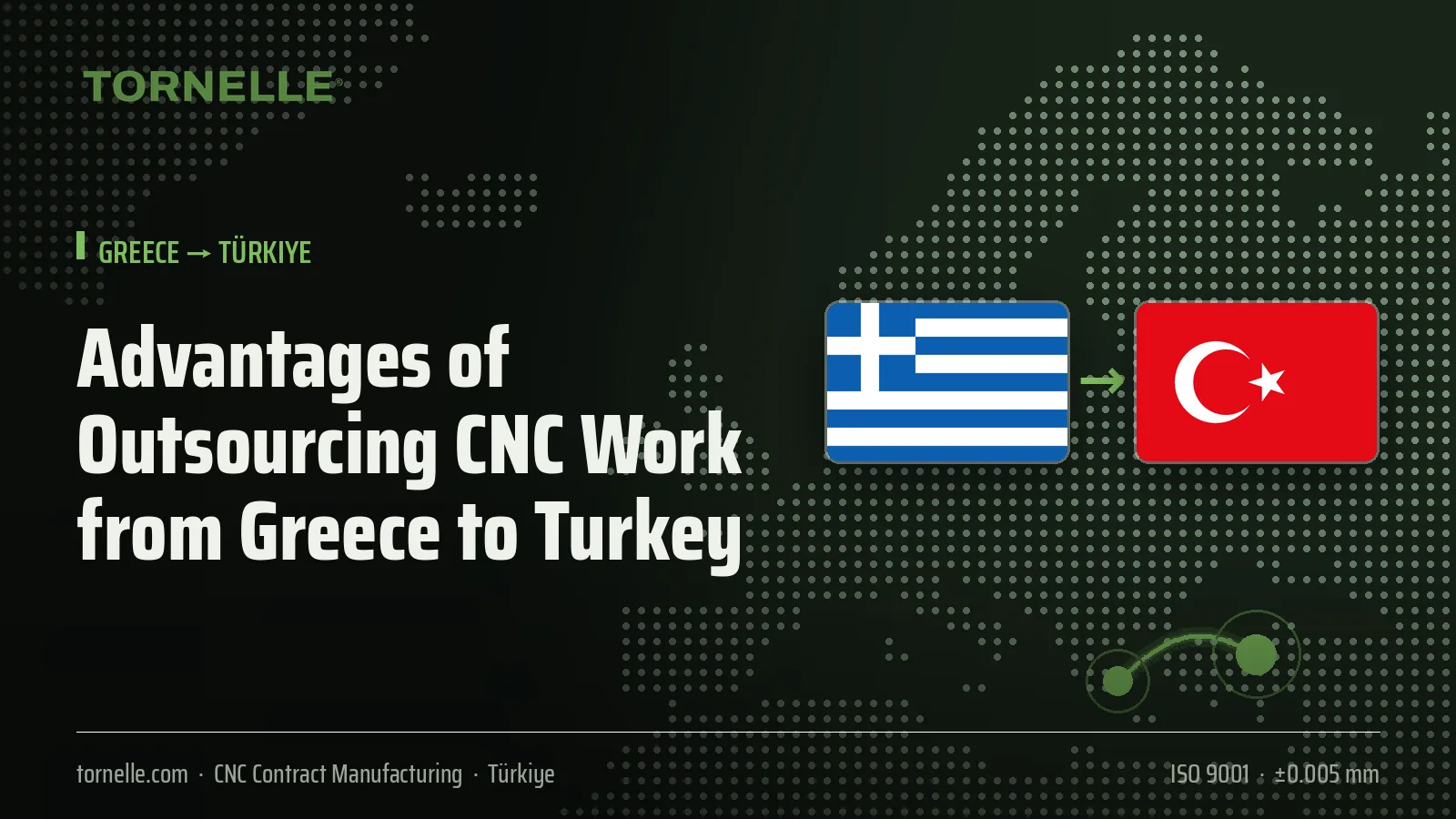
Independently of politics, the industrial relationship between Greece and Turkey has turned into a practical sourcing relationship in recent years: for Greek manufacturers, Turkey is the nearest large machining ecosystem reachable by road. The general advantages described in our guide to CNC contract manufacturing in Turkey have a specific meaning for the Greek buyer; this article makes them concrete.
1. Geography: Door to Door in 1–2 Days
The road distance from a workshop in Istanbul to Thessaloniki is about 600 km, to Athens 1,100 km. Trucks crossing at the Ipsala–Kipi border reach Thessaloniki the same or the next working day and Athens within 2 working days. That is shorter than delivery from a Northern European supplier to Greece (5–8 days). There are regular weekly groupage (LTL) departures; express couriers deliver urgent samples in 1–2 days. Logistics details are covered in our European logistics article.
2. Customs Union: No Duty with A.TR
The Customs Union between Turkey and the EU covers industrial goods; machined metal parts enter Greece duty-free with an A.TR movement certificate. On import only Greek VAT (ΦΠΑ, 24%) is declared, and VAT-registered companies deduct it; confirm the cash-flow effect and any deferral options with your customs broker. The document process is explained in our A.TR guide.
3. Cost: 30–45% Advantage over Western Europe
Local CNC capacity in Greece is limited and fragmented; most Greek manufacturers are used to buying parts from Italy or Germany. In Turkey, CNC turning hourly rates are typically 25–40 €, milling 30–50 €; in Italy 50–70 €, in Germany 70–100 €. Beyond the labour difference, domestic raw-material supply and high machine utilisation lower the unit price. For the cost components see our 12-factor article. Freight on the Greek route is low: groupage from Istanbul to Thessaloniki for one pallet of parts is usually 1–3% of the part value.
4. Experience Matching the Needs of Greek Industry
- Marine and ship equipment: Stainless and bronze flanges, shafts, bushings and pump bodies needed by the Piraeus–Perama shipyard zone; experience in corrosion-resistant materials.
- Food and beverage machinery: 1.4301/1.4404 stainless turned and milled parts with hygienic surface requirements for food-processing, olive-oil and wine equipment builders in Northern Greece.
- Energy and solar: Solar tracker systems, structural fasteners, aluminium profile machining; brass and copper conductor parts for transformers and switchgear.
- Aluminium sector: Profile finishing, drilling, milling and assembly for Greece's strong aluminium extrusion industry.
- Defence and aerospace suppliers: Small-batch, tight-tolerance aluminium and steel parts.
5. Same Time Zone, Similar Business Culture
Greece and Turkey work in the same time zone (a one-hour difference may occur during daylight saving); a technical question sent in the morning is answered before noon. The business culture is similar: personal relationships, quick solutions by phone and flexibility are valued. Technical English is standard at Turkish suppliers; most Greek buyers already work in English.
6. Easy Visits and Audits
Thessaloniki–Istanbul is 6–7 hours by road or 1 hour 20 minutes by air; the Athens–Istanbul flight takes 1.5 hours. A one-day supplier visit can be planned as an out-and-back trip. This is one of the clearest differences from Far East suppliers: travel costs for sample approval, problem solving or the annual audit are low.
7. Flexibility for Small and Medium Batches
Greek industry is predominantly SME-structured; order quantities range from 50 to 5,000. Turkish subcontract shops are used to this scale: mixed part families on 3–4-axis milling and CNC turning, plus high-volume small parts on Swiss-type lathes, can all come from one supplier. See our series production and prototype machining pages for the scope of services.
Points to Watch
- Request the A.TR certificate at quotation stage; without it, third-country duty may be applied.
- Clarify payment terms: 30–50% advance is common on first orders; regular relationships move to 30 days open account. Business is done in euros.
- Request quality documents in writing: Inspection report, EN 10204 3.1 material certificate, FAI if required.
- Plan for border crossing time: Waits of a few hours can occur at Ipsala–Kipi in busy periods; under DAP delivery this is the supplier's problem.
Example Scenario: A Machine Builder in Thessaloniki
A company in Thessaloniki building food-packaging machines was buying 40 different stainless turned and milled parts, 6,000 pieces per year in total, from Northern Italy. Its path to Turkey: first an RFQ for the 8 parts with the highest spend; quotes came in 35–40% below the Italian prices. The first order was a pilot batch of 50 pieces each for 3 parts; the samples reached Thessaloniki by courier in 2 days with inspection reports. After approval, a 6-month frame order with monthly call-offs followed; parts are delivered via Ipsala by weekly groupage truck in 1–2 days, no duty is paid thanks to A.TR, and VAT is accounted for in the Greek VAT return. After one year the total part cost had fallen by 31% and stock levels from 6 weeks to 2.
Practical lessons from this scenario
- Starting with 5–10 spend-weighted parts instead of moving the whole family at once limits the risk.
- A pilot batch plus a full inspection report shows the supplier's real quality better than any certificate.
- A frame order lets the Turkish supplier plan raw material and capacity; the price tier improves accordingly.
- Logistics on the Greece–Turkey route are so short that the safety-stock requirement is almost the same as with a local supplier.
Frequently Asked Questions
Is customs duty payable on parts shipped to Greece?
No; industrial goods shipped with an A.TR movement certificate enter duty-free under the Customs Union. Only import VAT is declared.
What is the delivery time to Thessaloniki?
1–2 working days by road after production is complete; 2–4 days for groupage loads depending on the weekly schedule.
Are small-quantity orders accepted?
Yes; from prototypes to several thousand pieces. As quantities rise, set-up costs are spread and the unit price falls.
Can I send technical drawings in Greek?
Dimensions and ISO symbols are universal; it is enough for critical notes to be in English. If anything is unclear, a technical meeting is held before quotation.
Conclusion
For Greek manufacturers, Turkey is the nearest, duty-free and fastest-reached large-scale source of CNC contract manufacturing. Delivery by road in 1–2 days, a 30–45% cost advantage and material experience matching the marine, food-machinery and energy sectors come together. Send your drawings and quantities via our quote form; you will receive an itemised, euro-based quote within 24 hours.