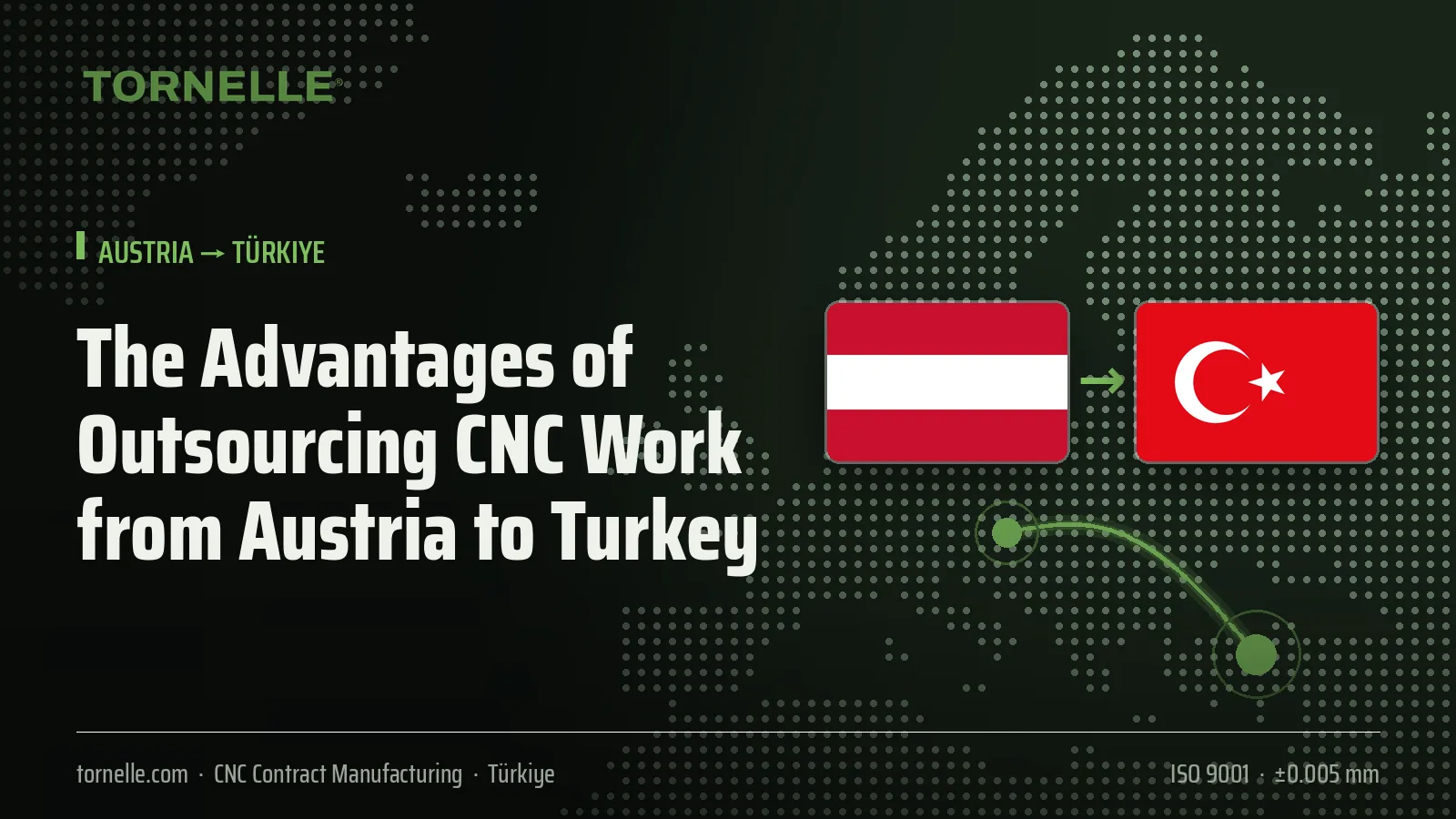
Austria is one of Europe’s strongest industrial nations relative to its population: the machinery and automotive clusters in Upper Austria and Styria, as well as the railway technology, energy and environmental technologies, hydraulics, and metalworking sectors. These companies, which share the German culture of quality, are seeking reliable supply alternatives in the face of rising costs and a shortage of skilled labor. Turkey stands out as the closest major manufacturing hub to Austria via the Balkan Corridor.
1. Customs Union: Zero Customs Duties
Thanks to the EU–Turkey Customs Union, CNC parts manufactured in Turkey enter Austria duty-free with an A.TR movement certificate. The Austrian importer only declares Einfuhrumsatzsteuer (import VAT), and for regular importers, this VAT is offset on the UVA return (via EUSt-Verrechnung without a cash payment). There are no customs duties or anti-dumping risks associated with sourcing from Asia. Details: Customs Union and A.TR Guide.
2. Balkan Corridor: 3–5 Business Days
The distance from Istanbul to Vienna is approximately 1,550 km, from Istanbul to Linz approximately 1,750 km, and from Istanbul to Graz approximately 1,500 km. Shipments are delivered in 3–5 business days via regular overland routes through the Bulgaria–Serbia–Hungary or Bulgaria–Romania corridors; Austria is one of the Western European countries most quickly accessible by road from Turkey. Air freight from Istanbul to Vienna takes 1 day.
3. ÖNORM, DIN, and German Technical Communication
Austrian technical drawings are based on ÖNORM EN ISO standards and are virtually identical to German DIN practice: ISO 2768 general tolerances, ISO 1101 geometric tolerances, EN 10204 certificates, German material designations (1.4301, 1.4571, 42CrMo4, 16MnCr5, EN AW-6082). Since the Turkish machining industry has been serving the German market for decades, this notation and terminology are part of everyday practice; technical communication in German is possible at most export-oriented suppliers. See also: Advantages for Germany.
4. Cost Advantage
In Austria, hourly costs for CNC machining are on par with those in Germany, while energy prices are above the European average. In Turkey, labor and overhead costs are significantly lower, and raw material prices are in line with global market rates. Austrian buyers typically see a total cost advantage of 30–45%—especially for labor-intensive, multi-operation parts with tight tolerances; low shipping costs (due to proximity) help maintain this advantage. Sample calculation: cost comparison.
5. Sectoral Alignment
- Machinery and plant engineering (Upper Austria): Steel and aluminum body parts, shafts, flanges — CNC milling and CNC turning.
- Automotive supply industry (Styria, Upper Austria): Precision-turned parts, PPAP and IATF experience.
- Railway technology: Alloy steel parts, EN 15085 and traceability requirements.
- Energy and environmental technologies: Stainless steel and duplex parts, hydroelectric components.
- Hydraulics and fasteners: High-volume sliding automatic machine parts.
6. Capacity and Flexibility
The long lead times experienced by SMEs in Austria for small-to-medium production runs are rarely seen in Turkey. Flexible capacity ranging from prototypes to high-volume call-off orders is offered as a one-stop solution, including heat treatment, coating, and assembly.
7. Time Zone and Transportation
Turkey is one hour ahead of Austria. The flight from Vienna to Istanbul takes approximately 2.5 hours, and there are numerous direct flights daily. Supplier audits can easily be conducted in a single day.
Practical Notes for Austrian Buyers
- Technical drawings may remain in German; list critical dimensions on a separate page.
- For the first order, request an Erstmusterprüfbericht and an EN 10204 3.1 certificate.
- Select FCA Istanbul or DAP factory as the Incoterms.
- Establish a framework agreement (Rahmenvertrag) and call-off order (Abrufauftrag) structure by sharing annual forecasts.
Frequently Asked Questions
Is there a customs duty on imports from Turkey to Austria?
No. Industrial products imported with an A.TR certificate are exempt under the Customs Union; only the import value-added tax (Einfuhrumsatzsteuer) is declared and offset.
Is communication in German possible?
Yes. Most Turkish suppliers serving the German market are proficient in German technical communication and reading German technical drawings.
What is the delivery time?
Production takes 1–2 weeks for prototypes and 3–6 weeks for mass production; delivery to Austria takes 3–5 business days by road and 1 day by air freight.
How does the process work?
The steps are the same as for Germany: See our guide on how to outsource CNC work from Germany to Turkey.
Conclusion
Outsourcing CNC work from Austria to Turkey means working with a supplier that operates according to German quality standards, communicates in German, and delivers in less than a week via the Balkan corridor. Send us your technical drawings and receive a quote within 24 hours.