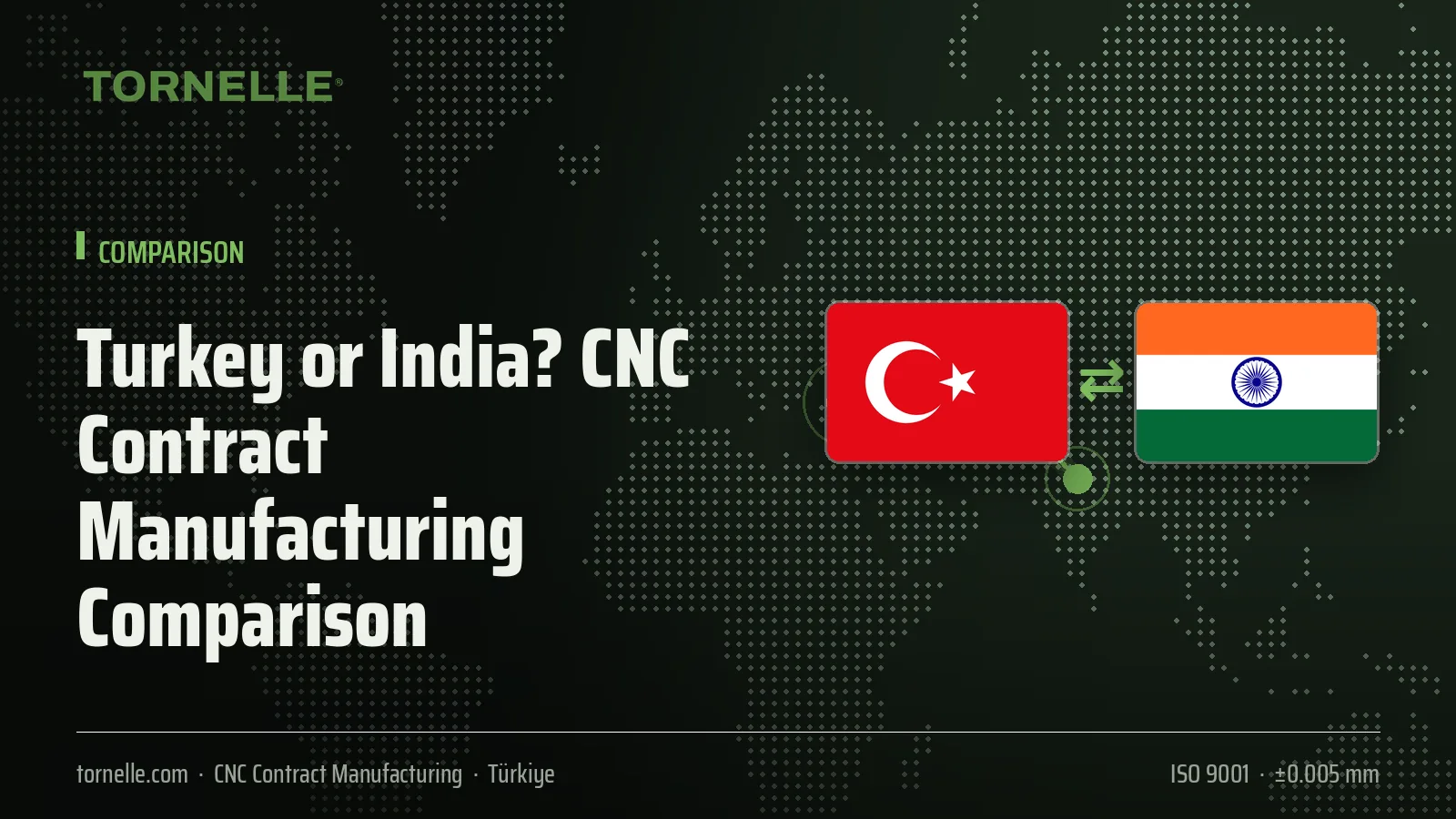
When European purchasers look for a sourcing option outside China, two countries stand out: Turkey and India. India has a broad machining base in centres such as Pune, Bangalore, Chennai, Coimbatore and Rajkot and very low labour costs. Turkey is a production base integrated with Europe geographically and in customs terms. Which one is right? The answer depends on part type, quantity and your supply chain priorities. We now apply the framework from our article Turkey or China to India.
Comparison Table
| Criterion | Turkey | India |
|---|---|---|
| Machine hourly rate (3-axis, typical) | €28–45 | €15–28 |
| Unit price (labour-intensive part, ex works) | Reference | 10–25% lower |
| EU customs duty | 0% (A.TR, Customs Union) | Third-country tariff; typically 0–4.5% on machine parts |
| Customs document | A.TR, no rules of origin | Certificate of origin, full import declaration |
| Lead time (to Germany) | Road 3–6 days | Sea 30–40 days; air 5–7 days |
| Freight share (of part value) | 2–4% | Sea 3–6%, air 10–25% |
| Time difference (Central Europe) | 1–2 hours | 3.5–4.5 hours |
| Technical communication language | English, often German | English (strong) |
| Standards culture | EN/ISO/DIN | Mixed IS/BS/ASME; EN familiarity growing |
| Quality consistency | High (automotive/defence supply chain) | Varies greatly by supplier |
| Economic batch size | 1 – 100,000 | Medium to high volume; low volume expensive |
| Intellectual property | Close to European law, enforceable | Legal framework exists, enforcement slow |
| Revision / sample loop | 1–2 weeks | 4–8 weeks |
Values are typical ranges for export-oriented, medium-sized workshops; they vary from company to company.
Unit Price: India Ahead
On ex-works price India is 10–25% cheaper on labour-intensive parts; on very high-volume parts with low technical requirements the gap can widen further. On material-heavy parts the difference is small, because steel and aluminium are priced globally. India's advantage is particularly clear on simple turned and milled parts in batches of 10,000+.
Total Cost: The Gap Closes
The picture changes when you add the following to the unit price:
- Customs duty: 0% with A.TR from Turkey; 0–4.5% from India depending on HS code (at the time of writing, no EU–India free trade agreement is in force; check the current status).
- Freight and insurance: sea freight is cheap but slow; in urgent cases air freight wipes out the advantage completely.
- Inventory cost: 30–40 days of transit plus safety stock; cost of capital and warehouse space.
- Quality risk: an out-of-tolerance batch is detected 5–6 weeks later; the remanufacturing and shipping loop takes 2–3 months.
- Management overhead: time difference, long sample loops, supplier development visits.
With these items, India's 10–25% unit price advantage mostly falls to 0–10% or is reversed on medium-volume, technical parts. For the calculation method see our cost comparison article.
Decision by Part Type
- Simple, very high volume, cheap material, wide tolerances: India (or China) wins on unit price; inventory can be managed with 2–3 planned sea shipments a year.
- Medium volume, technical requirements, frequent revisions: Turkey; short loops and quality consistency are decisive.
- Tight tolerances, certified, automotive/medical/defence: Turkey; the certification and traceability culture is established.
- Prototypes and small series: Turkey; low volumes are not economical in India and the sample loop is long.
- Small-diameter series Swiss-type parts: capacity exists in both countries; Turkey stands out with delivery speed and its density of Swiss-type lathes.
India's Strengths
To be fair, India's advantages are real: a very large labour pool, strong English, a rapidly developing automotive and aerospace supply chain, economies of scale at large volumes and government-backed manufacturing incentives. Once the right supplier is found and the volume is high, India is an efficient source. The problem is that finding and developing the right supplier is a long and costly process.
Turkey's Strengths
A customs process that works like intra-EU sourcing thanks to the Customs Union, 3–6 days by road, same-working-day replies, a natural command of EN/ISO/DIN standards, quality discipline stemming from the automotive and defence supply chain, and flexibility from prototype to series. All of these are covered in detail in our guide to CNC contract manufacturing in Turkey.
Frequently Asked Questions
How much cheaper is India than Turkey?
10–25% on ex-works price for labour-intensive parts. When customs, freight, inventory and quality risk are added, the gap mostly closes on medium-volume parts.
Is there customs duty from India into the EU?
Yes; the third-country tariff applies, typically 0–4.5% on machine parts. From Turkey it is 0% with A.TR.
Does it make sense to use both countries together?
Yes. The common model: high-volume simple parts from India/China, technical and medium-volume parts from Turkey. Cost and risk are balanced this way.
How important is the lead time difference?
Very important for products with frequent revisions and fluctuating demand; less so for fixed-design products with annual planning.
Conclusion
India leads on unit price, Turkey on total cost, speed and quality consistency. For parts with technical requirements, medium volumes or frequent revisions Turkey is the logical choice; for very high-volume simple parts, India. If you would like a real comparison for your own parts, send your technical drawings via our quote form and receive an itemised, DAP-priced quote.