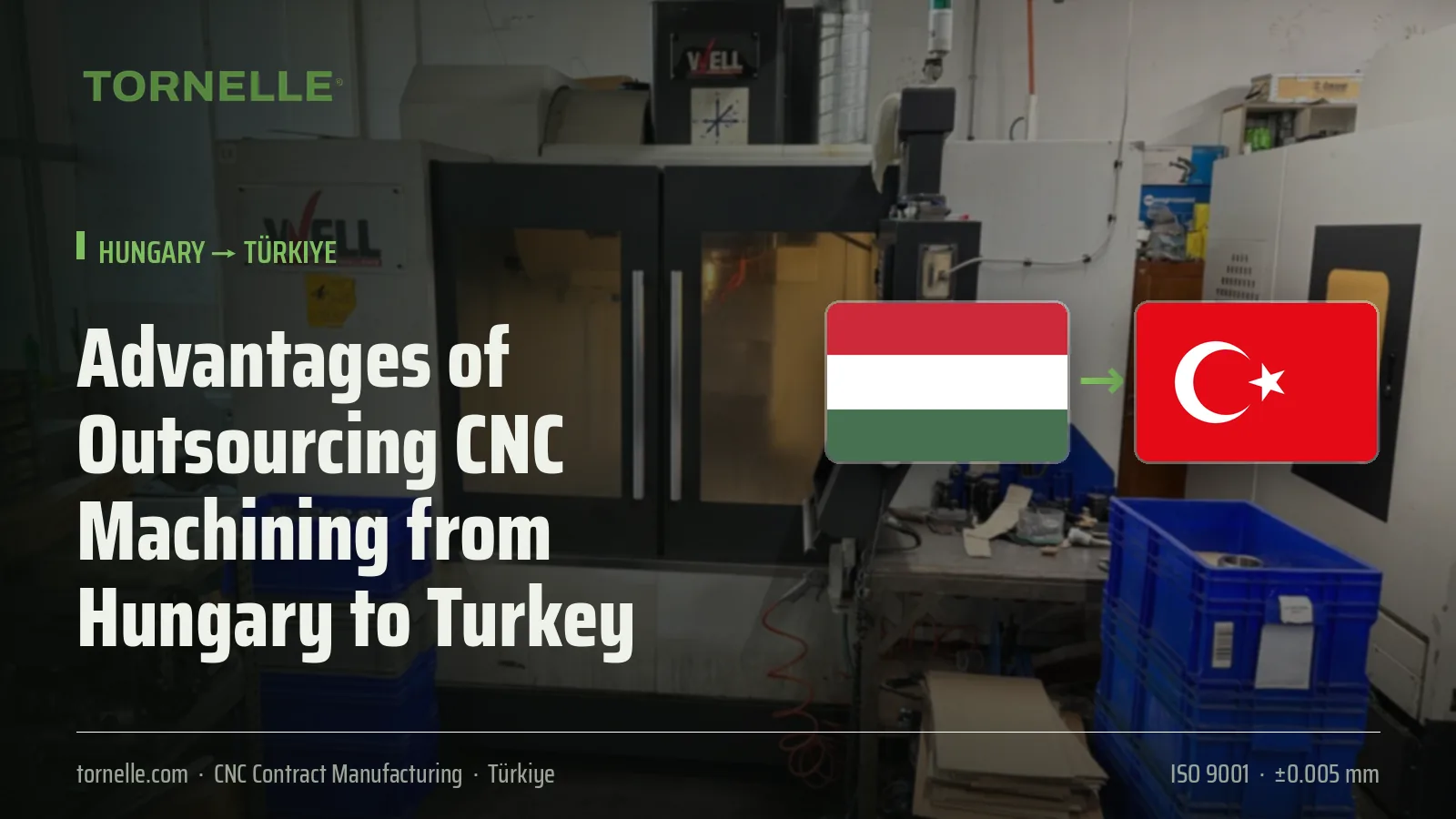
With the Audi plant in Győr, Mercedes-Benz in Kecskemét, BMW in Debrecen and Suzuki in Esztergom, Hungary is one of Europe's leading countries in automotive production; in recent years giant battery-cell investments have been added. This density is straining local CNC subcontracting capacity: because of a shortage of skilled operators, rapidly rising wages and fully booked machine parks, Tier-1 and Tier-2 suppliers struggle to find capacity for new projects. In this article we look at the advantages that CNC contract manufacturing in Turkey offers Hungarian manufacturers.
1. Customs Union and A.TR: Zero Customs Duty
Thanks to the Customs Union between Turkey and the EU, CNC-machined industrial parts enter Hungary without customs duty under the A.TR movement certificate. Hungarian VAT (27%, the highest in the EU) applies on import; because it is fully recoverable for VAT-registered businesses there is no net cost effect, but it is useful to plan the payment timing with your tax adviser for cash-flow reasons. For details see our A.TR guide.
2. Logistics: 3–4 Days by Road
Istanbul and Budapest are about 1,500 km apart; road transport via Bulgaria–Serbia or Romania takes 3–4 working days door to door. There is heavy truck traffic and weekly groupage services on the Turkey–Central Europe route; regular access is provided to the industrial regions of Győr, Kecskemét, Debrecen and Székesfehérvár. In urgent cases, air freight with direct Istanbul–Budapest flights takes 1–2 days.
3. Cost: A Realistic Comparison
Hungary is a medium-to-low-cost country within the EU; Turkey's price advantage is narrower than against Germany and wider than against Romania. In Hungary, 3-axis turning and milling hourly rates are typically €35–50, in Turkey €28–45. On a per-part basis Turkey's advantage is generally 15–30% and becomes more pronounced on labour-intensive parts. The real gain is usually capacity and delivery reliability: getting parts from Turkey in 3–5 weeks while local workshops are fully booked means not disrupting the OEM schedule. For the calculation approach see our cost comparison article.
4. Sector Fit
- Automotive: the German OEM supply chain; turned and milled steel/aluminium parts, PPAP/VDA 2 requirements, IATF-compliant processes. Because Turkey's own automotive industry supplies the same OEMs, the expectations are familiar.
- Battery and electric vehicles: aluminium housing and cooling parts, copper and brass connection elements, fixture and line-equipment parts.
- Electronics and medical: precision aluminium and stainless parts, connector components, device housings.
- Machinery and automation: fixtures, shafts, bushings, gear blanks, hydraulic components.
5. Same Standards, Close Time Zone
Under the influence of German OEMs, Hungarian industry works with DIN/EN/ISO and VDA standards; Turkey's export industry works with the same standards. The time difference is 1 hour in summer and 2 hours in winter. Technical communication in English and German is standard; quality assurance expectations (inspection report, 3.1 certificate, PPAP) are in the format known from the German supply chain.
6. Flexible Series and Swiss-Type Capacity
Automotive and electronics suppliers look for capacity for medium-volume (1,000–50,000 pieces) turned parts. Turkey's Swiss-type turning capacity and its flexible structure from prototype to series enable fast ramp-up in this segment; sample, PPAP and series stay with the same supplier.
Points to Consider
- 27% VAT affects cash flow; plan import VAT deferral or offset options with your tax adviser.
- Make sure the A.TR certificate accompanies the shipment and clarify the delivery term (FCA or DAP) at the quotation stage.
- For automotive parts, state the PPAP level and special characteristics in the RFQ.
- The Serbian route involves non-EU transit; make sure your forwarder is experienced on the Balkan route.
Frequently Asked Questions
Is there customs duty on importing CNC parts from Turkey into Hungary?
No; industrial products within the Customs Union enter duty-free under the A.TR certificate. Only recoverable Hungarian VAT (27%) applies.
What is the lead time?
Production 3–5 weeks (1–2 weeks for prototypes); road freight 3–4 working days.
How much cheaper is Turkey than a local workshop in Hungary?
15–30% depending on the part; more on labour-intensive parts. Capacity and delivery reliability are usually the main gain.
In which currency are prices quoted?
Euros; on request the HUF equivalent is added for reference.
Conclusion
For Hungarian manufacturers, Turkey is a strong external sourcing alternative, with 3–4-day road freight, duty-free supply under A.TR, command of German OEM standards and flexible series production against capacity bottlenecks. Send your technical drawings and quantities via our quote form; you will receive an itemised, euro-based quote within 24 hours.