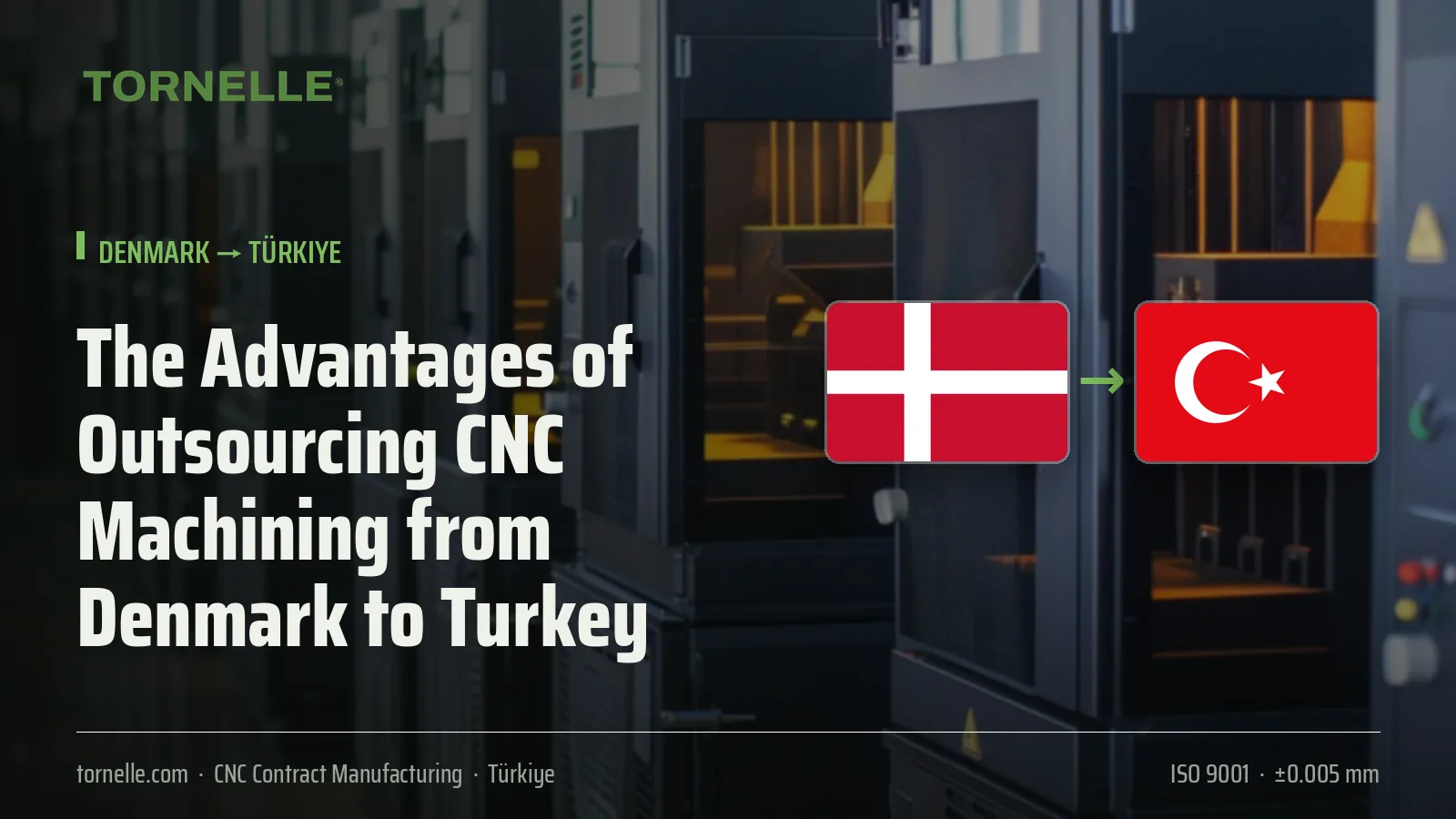
The Danish industrial sector is small but highly specialized: wind turbines and renewable energy, pump and valve technologies, food and pharmaceutical processing machinery, hearing aids and medical technology, and agricultural equipment. A common expectation across these sectors is high quality, hygienic design, and comprehensive documentation for stainless steel and precision parts. Denmark’s high labor costs and limited CNC capacity drive companies toward reliable external suppliers. Turkey is a suitable option that meets these requirements in terms of both quality and cost.
1. Zero Customs Duties Through the Customs Union
Denmark is an EU member; CNC parts manufactured in Turkey enter Denmark duty-free with an A.TR movement certificate. Import VAT (importmoms) is not paid at customs; it is declared on the VAT return and offset. Details: Customs Union and A.TR Guide.
2. Delivery Time: 5–7 Business Days by Road
The distance from Istanbul to Copenhagen is approximately 2,900 km, and from Istanbul to Aarhus is approximately 3,000 km. Parts are delivered within 5–7 business days via regular road transport routes through Germany; distribution to industrial areas in Jutland is straightforward. By air freight, the journey from Istanbul to Copenhagen takes 1–2 days. Compared to sea freight from Asia, inventory requirements are significantly reduced.
3. Experience in Stainless Steel and Hygienic Design
Denmark’s food, pharmaceutical, and pump industries have high expectations for stainless steel components. Turkish suppliers:
- have experience with CNC turning and CNC milling of 1.4301, 1.4404, 1.4571, and duplex steels;
- can achieve surface finishes of Ra 0.8 or lower, as well as electropolishing and passivation;
- are familiar with EHEDG and 3-A hygienic design principles (cornerless transitions, drainable surfaces);
- Provide EN 10204 3.1 certification and full material traceability.
4. Wind Energy and Large-Part Capacity
The wind turbine supply chain requires a wide variety of CNC-machined parts, such as hydraulic components, fasteners, yaw and pitch system parts, and sensor housings. Turkey holds an established position in Europe’s wind energy supply chain through the production of towers, blades, and components; this ecosystem also fuels CNC machining capacity.
5. Cost Advantage
In Denmark, the hourly cost of CNC machining is among the highest in Europe. In Turkey, labor and overhead costs are significantly lower, while raw material prices are global. Danish buyers typically see a total cost advantage of 35–50%—particularly for labor-intensive, multi-operation stainless steel parts. Calculation logic: cost comparison.
6. Standards and Communication
Danish technical drawings are based on DS/EN ISO standards (ISO 2768, ISO 1101, ISO 1302)—standard practice for Turkish suppliers. Technical communication is seamless, as Danish engineers are fluent in English. ISO 14001 certifications and emissions data can be provided to meet sustainability expectations.
7. Time Zone and Transportation
Turkey is 1 hour ahead of Denmark. The flight from Copenhagen to Istanbul takes approximately 3.5 hours, and there are daily direct flights. Supplier audits can be conducted in a single-day visit.
Sector-Specific Compliance Summary
- Pumps and valves: Stainless steel shafts, housings, and impellers.
- Food and pharmaceutical machinery: Hygienically designed stainless steel parts.
- Wind energy: Hydraulic and mechanical components.
- Medical and hearing aids: Micro-parts — sliding automatic machine.
- Agricultural equipment: Steel turned and milled parts.
Practical Notes for Danish Buyers
- Clearly specify hygienic design and surface requirements (Ra, electropolishing) in the RFQ.
- Request a measurement report and an EN 10204 3.1 certificate for the first order.
- Select FCA Istanbul or DAP factory as the Incoterms.
- Pricing in EUR rather than DKK is common; currency risk is low due to the fixed DKK–EUR exchange rate band.
Frequently Asked Questions
Is there a customs duty on imports from Turkey to Denmark?
No. Industrial products arriving with an A.TR certificate are exempt under the Customs Union; import VAT is offset on the VAT return.
Are stainless steel parts suitable for food contact produced?
Yes. Parts suitable for food contact, made from 1.4404/1.4571 material with a surface roughness of Ra 0.8 or lower, and treated with electropolishing and passivation, are produced along with a material certificate.
What is the lead time?
Production takes 1–2 weeks for prototypes and 3–6 weeks for mass production; delivery to Denmark takes 5–7 business days by road and 1–2 days by air freight.
How does the process work?
A comprehensive guide to the general steps and an RFQ guide.
Result
Outsourcing CNC machining from Denmark to Turkey is a duty-free and fast supply strategy that meets high-quality expectations for stainless steel and precision parts while offering a significant cost advantage. Send us your technical drawings and receive a quote within 24 hours.