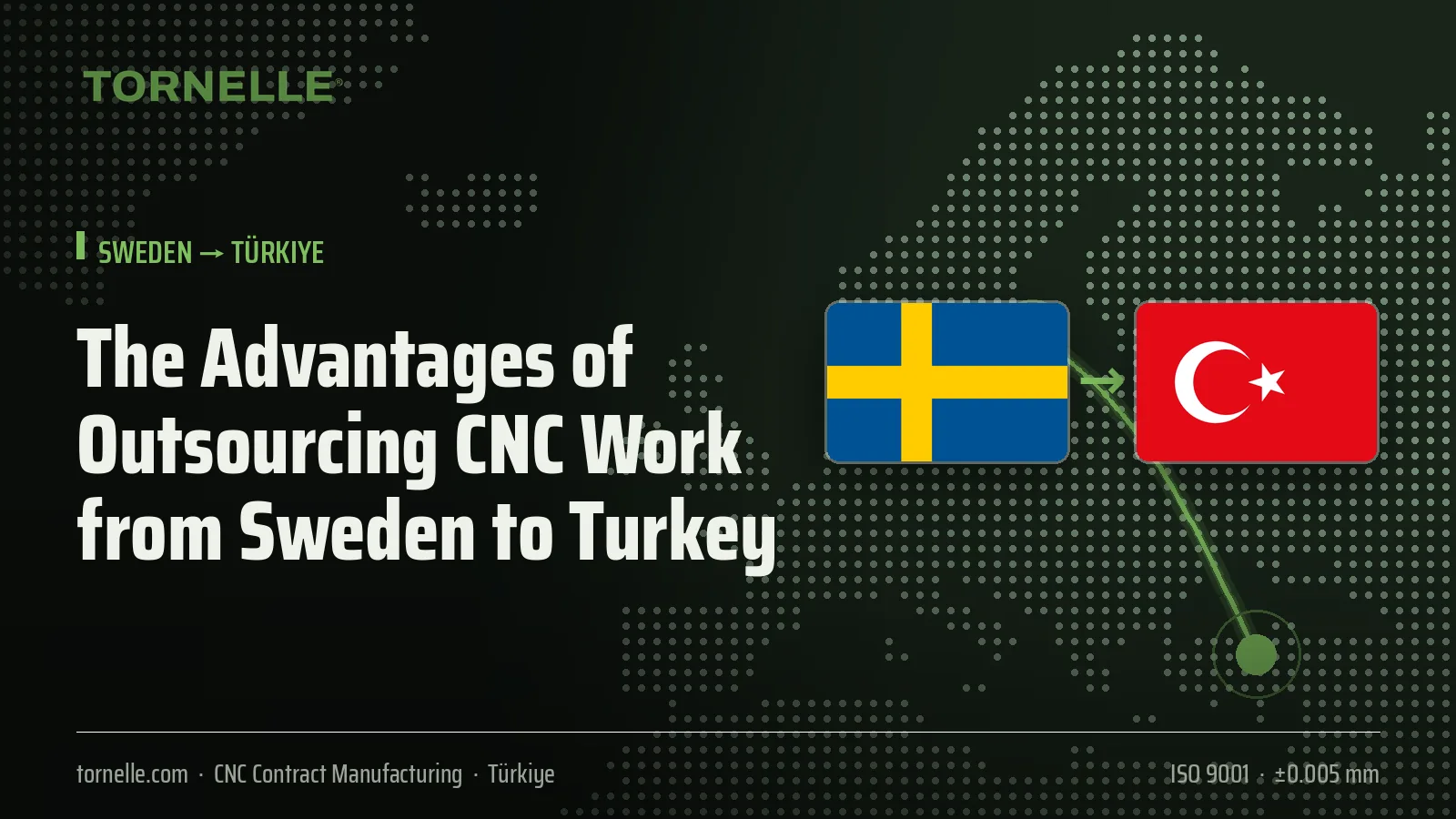
The Swedish industrial sector has a global impact far beyond its size: heavy-duty vehicles and automotive, mining and construction equipment, bearings and power transmission, energy and environmental technologies, defense, and aerospace. The supply chains in these sectors are managed according to criteria of quality, traceability, and, increasingly, sustainability. At the same time, Sweden is among the European countries with the highest labor costs, and it is becoming increasingly difficult to find CNC operators. Turkey is a sourcing option that offers a cost advantage while meeting expectations for quality and accountability.
1. Zero Customs Duties Through the Customs Union
Sweden is an EU member; CNC parts manufactured in Turkey enter Sweden duty-free with an A.TR movement certificate. Swedish importers declare and offset the import VAT (importmoms) directly on their VAT return; there is no payment at customs. Details: Customs Union and A.TR Guide.
2. Delivery Time: 6–8 Business Days by Road, 2 Days by Air Freight
The distance from Istanbul to Gothenburg is approximately 3,200 km, and from Istanbul to Stockholm is approximately 3,400 km. Road delivery via Germany and Denmark (Öresund) or via Germany–Sweden ferry connections typically takes 6–8 business days. Air freight from Istanbul to Stockholm/Gothenburg takes 1–2 days. Compared to 6–8-week sea freight shipments from Asia, the time and inventory advantages are significant; additionally, shipping costs are optimized through regular consolidated shipments.
3. SS-EN ISO Standards and Communication in English
Swedish technical drawings are based on SS-EN ISO standards (ISO 2768, ISO 1101, ISO 1302)—a common practice among Turkish suppliers. Swedish material designations (e.g., SS 2343 / 1.4436, SS 2172 / S355) can be easily matched to their European equivalents; export-oriented suppliers are familiar with these conversions. Since Swedish engineers are comfortable using English, technical communication is seamless.
4. Sustainability and Responsible Sourcing
Swedish companies clearly state their expectations regarding environmental and social compliance from suppliers. Turkish suppliers are becoming increasingly well-prepared in this regard:
- ISO 14001 environmental management and ISO 45001 occupational health and safety certifications are becoming widespread;
- The carbon footprint of road transport is low compared to the sea-and-road combination from Asia, thanks to shorter distances;
- Turkey’s share of renewable energy (hydroelectric, wind, solar) is increasing;
- Chip recycling and coolant management are standard practices;
- Data can be provided for CBAM and supplier codes of conduct.
5. Cost Advantage
The hourly cost of CNC machining in Sweden is among the highest in Europe. While labor and overhead costs in Turkey are significantly lower, raw material prices are global. Swedish buyers typically see a total cost advantage of 35–50% on labor-intensive, multi-operation parts; although the shipping distance is longer than from Central Europe, this difference does not negate the cost advantage. Calculation logic: cost comparison.
6. Industry-Specific Alignment
- Heavy-duty vehicles and automotive: Precision steel and aluminum parts, PPAP and IATF experience.
- Mining and construction equipment: Alloy steel shafts, bushings, hydraulic components—CNC turning.
- Bearings and power transmission: Tight-tolerance turned and ground parts.
- Energy and environmental technologies: Stainless steel and duplex parts, heat pump and wind turbine components.
- Defense and aerospace: Milled aluminum and titanium parts — CNC milling.
7. Time Zone and Transportation
Turkey is 1 hour ahead of Sweden. The flight from Stockholm to Istanbul takes approximately 4 hours; there are also flights from Gothenburg. Supplier audits can be conducted with a one-day visit; video audits are a common alternative.
Practical Notes for Swedish Buyers
- Share your supplier code of conduct and sustainability questionnaire along with the RFQ.
- Request a measurement report and an EN 10204 3.1 certificate for the first order.
- Select FCA Istanbul or DAP factory as Incoterms; reduce shipping costs with consolidated shipments.
- Pricing in EUR rather than SEK is common; agree on an exchange rate band.
Frequently Asked Questions
Is there a customs duty on imports from Turkey to Sweden?
No. Industrial products arriving with an A.TR certificate are exempt under the Customs Union; import duties are offset on the VAT return.
Are sustainability certificates provided?
Yes. ISO 14001/45001 certificates, code of conduct approval, and CBAM emissions data are provided upon request.
What is the delivery time?
Production takes 1–2 weeks for prototypes and 3–6 weeks for mass production; delivery to Sweden takes 6–8 business days by road and 1–2 days by air freight.
How does the process work?
A comprehensive guide on general steps and an RFQ guide.
Conclusion
Outsourcing CNC machining from Sweden to Turkey is a sourcing strategy that offers a significant cost advantage while meeting expectations for quality, traceability, and sustainability. Send us your technical drawings and receive a quote within 24 hours.