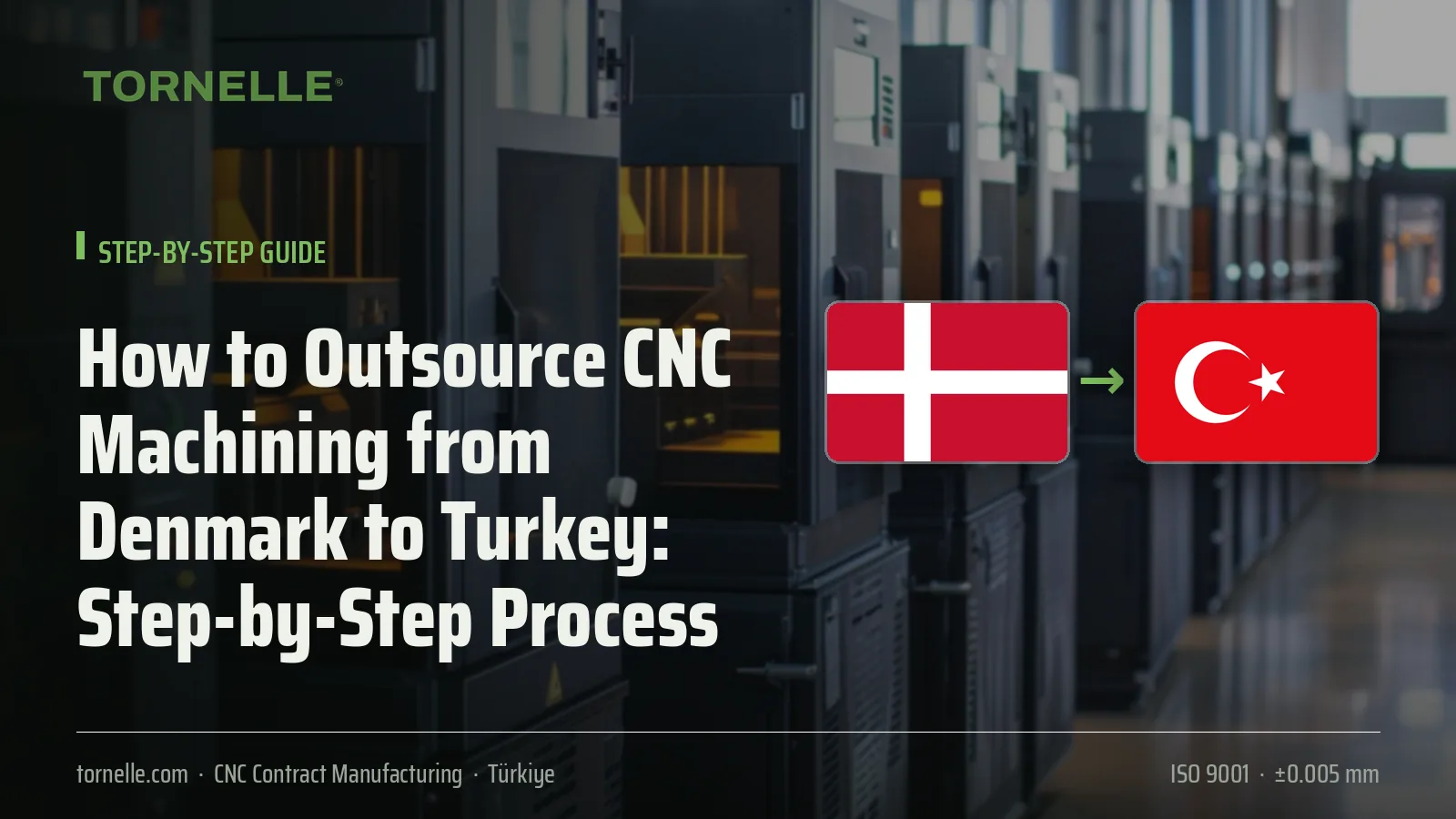
You already know the advantages Turkey offers Danish companies: a 35–50% cost advantage, the Customs Union, European standards and the documentation discipline the wind, pump, hydraulics and medical sectors expect. This article explains step by step how to place the first order in practice, with particular attention to Denmark-specific logistics and VAT points.
Step 1: Prepare the Technical Documents
Danish drawings are prepared to DS/EN ISO standards and are read without difficulty in Turkey; add an English equivalent for critical Danish notes (English drawings are common in Danish industry anyway). The ideal package:
- STEP (AP214) 3D model + PDF technical drawing; revision numbers must match.
- Material with its EN grade (S355J2, 42CrMo4, 1.4404, 1.4462 duplex, EN AW-6082, CW614N, machining of EN-GJS-500-7 castings). For wind and marine parts, state the grade and certificate expectations.
- General tolerance (ISO 2768-mK) in the title block; geometric tolerances with their datums.
- Surface roughness (Ra), edge breaks, heat treatment, coating (for wind components, coating systems for corrosivity category C4/C5).
- Annual quantity, batch size, first-order quantity and target date.
- Documentation expectations: inspection report, EN 10204 3.1, FAI; reference to OEM supplier standards in the wind supply chain, process validation in medical.
Step 2: Request and Compare Quotes
Send the RFQ to 2–3 Turkish suppliers and compare quotes line by line: unit price (quantity breaks), set-up, certificates, inspection report, packaging, Incoterm and lead time. In Denmark, sustainability and supplier codes of conduct frequently appear in the RFQ; you can ask the Turkish supplier for a signed code of conduct and transport emissions data. For the method, see our RFQ guide.
Step 3: Clarify the Commercial Terms
Incoterms
FCA Istanbul (your own forwarder collects) or DAP (the Turkish supplier delivers to your door; the import declaration and moms are yours). On the Denmark lane, groupage loads mostly transship in Germany; under DAP this is not your concern. Details are in our Incoterms guide.
Payment
In Denmark, 30 days net is customary ("løbende måned + 30" is also common). For export sales, Turkish suppliers work with partial advance payment (30–50%) plus the balance before shipment on first orders, and 30-day open account in an established relationship. Prices are mostly in EUR; as the DKK is pegged to the euro, currency risk is negligible, and a DKK reference can be added if you request DKK pricing. SWIFT transfer is standard.
Contract and confidentiality
An English-language NDA and quality agreement are sufficient; a supplier code of conduct can be signed by the Turkish supplier. Governing law and venue for disputes should be specified.
Step 4: Samples and First Article Approval
For the first order, request 1–5 samples and a full inspection report against a ballooned drawing. For wind and marine suppliers, FAI + material certificate + coating report; for medical, FAI + process validation; for general machinery, a standard FAI is sufficient. Verify the report with your own measurements; series production starts after approval. The process is described in our FAI guide.
Step 5: Logistics, Customs and Import
- Road: Istanbul to Copenhagen, Aarhus or Aalborg door to door in 6–7 working days; via Germany directly by road to Jutland or via the Rødby–Puttgarden ferry. Weekly groupage departures are available.
- Sea: For large and heavy loads (wind components), Istanbul–Aarhus/Copenhagen container 2–3 weeks.
- Air freight: Istanbul–Copenhagen 1–2 days; express courier 2–3 days for samples.
- Customs duty: Parts enter duty-free with an A.TR movement certificate. Document details are in our A.TR guide.
- Importmoms (VAT): VAT-registered Danish companies do not pay import VAT (25%) at the border; they declare it in the periodic VAT return and deduct it in the same return. There is no cash outflow.
- Declaration: The forwarder lodges the import declaration in the Toldstyrelsen system under your EORI number; commercial invoice, packing list, A.TR and CMR are sufficient.
Step 6: Series Deliveries and Continuous Improvement
Framework agreements and call-off orders are common; because of the transit time, planning 2–4 weeks of safety stock is useful. Each batch ships with an inspection report and 3.1 certificate in the package. After the first 2–3 batches, price, packaging and frequency settle; OTD and PPM data can be shared for supplier evaluation. Annual supplier audits are common in the wind and pump supply chain; they can be carried out by video audit or a visit to Istanbul.
Common Mistakes
- Planning transit time as for Central Europe (3–5 days); 6–7 days is realistic.
- Not specifying the coating system and corrosivity category in the RFQ for wind and marine parts.
- Sending critical Danish notes without translation.
- Raising sustainability and code-of-conduct expectations only after the quote.
- Comparing unit price alone without aligning the full scope.
Frequently Asked Questions
Can I send technical drawings in Danish?
Yes; dimensions and symbols are international. English drawings are already common in Danish industry; it is sufficient for the critical notes to be in English.
How much time should I plan for the first order?
Quote 1–2 days, samples 1–3 weeks, series 3–5 weeks after approval, transport 6–7 days: the first series batch is typically in your hands in 7–11 weeks.
How does the process work in case of a complaint?
Notification with photo and measurement evidence, 8D report, remanufacture or credit note, defined in writing in the quality agreement. Replacement supply by air freight is possible in 1–2 days.
Do I need to visit the supplier in Turkey?
Not mandatory; with a 3.5-hour direct flight Copenhagen–Istanbul, an overnight audit is feasible.
Conclusion
Outsourcing CNC machining from Denmark to Turkey is a predictable process: the right document package, a line-by-line quote, sample approval and a simple, duty-free import under A.TR with importmoms offset in the VAT return. Send your technical drawings and quantities via our quote form; you will receive a line-by-line quote in euros (with a DKK reference on request) within 24 hours. For the process steps, see our how we work page.