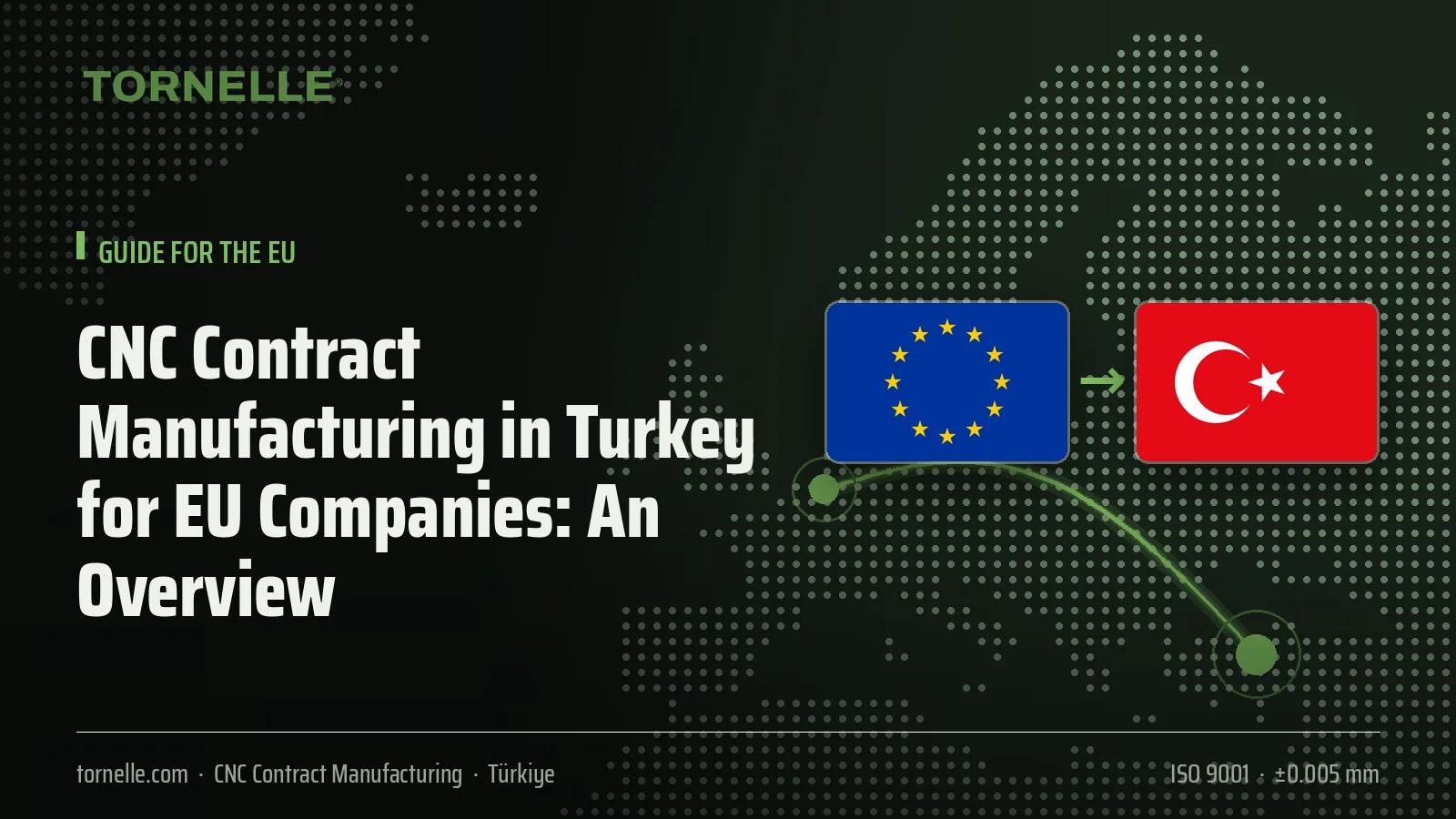
For manufacturers in the European Union, supply-chain decisions have been shaped by three pressures in recent years: rising labour and energy costs, a shortage of skilled operators and the logistical and geopolitical risks of Far East sourcing. In this picture Turkey stands out as a machining base that neighbours the EU, sits inside the Customs Union, works to European standards and offers competitive costs. This article is the EU-perspective summary of our guide to CNC contract manufacturing in Turkey and the gateway to our country-specific articles.
1. Commercial Framework: Customs Union and A.TR
The Customs Union between Turkey and the EU (1996) covers industrial products. CNC-machined parts produced in Turkey or in free circulation there enter the EU's 27 member states without customs duty under the A.TR movement certificate; no rule of origin is applied, only free-circulation status is documented. On import, only the VAT of the respective country applies, and it is recoverable for VAT-registered businesses. This structurally separates Turkey from China, India or Vietnam (EU customs duty + rules of origin + longer logistics). For details see our A.TR guide.
Customs clearance is handled by the forwarder on behalf of the importer; the EU company's EORI number is sufficient. There is no EU import licence, quota or special permit for industrial parts from Turkey.
2. Cost Structure
In Turkey, 3-axis CNC turning and milling hourly rates are typically in the €28–45 band; €40–60 on Swiss-type and multi-axis machines. Compared with Western and Northern Europe, per-part savings are generally at the following levels:
| Region | Typical local hourly rate (3-axis) | Typical per-part saving with Turkey |
|---|---|---|
| Germany, Austria, Netherlands, Belgium | €65–95 | 30–45% |
| Scandinavia, Switzerland | €75–120 | 35–50% |
| France, Italy, Spain, Ireland | €55–85 | 25–40% |
| Poland, Czechia, Hungary | €35–55 | 15–30% |
| Romania, Bulgaria | €30–45 | 10–25% |
Savings are highest on parts with a high labour share (long cycle times, multiple operations, medium series) and lower on parts with a high material share (large volume, expensive alloys). Freight typically adds 2–6% of the part value. For manufacturers in Eastern Europe, Turkey's main contribution is capacity and delivery reliability rather than price. For the method see our cost comparison article.
3. Quality and Standards Alignment
Turkish export industry works to European standards: DIN/EN/ISO drawing and tolerance standards (ISO 2768, ISO 286, ISO 1101), EN material grades (1.4404, 42CrMo4, EN AW-6082), EN 10204 material certificates, ISO 9001 quality systems and, in automotive, IATF 16949 / PPAP / VDA 2 practices. Turkey is one of the EU's largest automotive, household-appliance and machinery suppliers; these supply chains have shaped Turkish subcontracting workshops to European quality expectations for years. To define your expectations in writing, our quality assurance article provides guidance.
4. Logistics Times
| Destination region | Road (door to door) | Air freight |
|---|---|---|
| Bulgaria, Romania, Greece | 2–3 working days | 1–2 days |
| Hungary, Austria, Czechia, Slovakia, Poland (south) | 3–5 working days | 1–2 days |
| Germany, Italy (north), Slovenia, Croatia | 4–6 working days | 1–2 days |
| Netherlands, Belgium, France, Denmark | 5–7 working days | 2 days |
| Spain, Portugal, Sweden, Finland, Ireland | 7–10 working days | 2–3 days |
Weekly groupage (LTL) services are available to all major EU industrial regions; the cost per pallet is no different from Far East sea freight + inland transport, but the time is 1 week instead of 4–8 weeks. For route details see our logistics guide.
5. Time Zone, Language and Communication
Turkey is on UTC+3; the difference from Central Europe is 1 hour in summer and 2 hours in winter. The entire working day overlaps; the day lost when working with the Far East does not exist here. English is standard in export-oriented workshops, and German is common. For technical visits, Istanbul is a 2–4-hour direct flight from all major European cities; a same-day audit is possible.
6. Which Parts Suit Turkey?
- Very suitable: medium-series (100–50,000 pieces) turned and milled steel, stainless, aluminium and brass parts; Swiss-type parts; labour-intensive, multi-operation housings; finished parts including plating/heat treatment; projects moving from prototype to series.
- Suitable: low-volume technical parts (proximity and speed advantage), spare parts requiring reverse engineering.
- To be assessed carefully: very high-volume simple parts dominated by material cost (the Far East may be competitive); parts requiring mandatory AS9100 or ISO 13485 certification (the number of certified suppliers is limited); defence parts subject to export control.
7. Country-Specific Differences
The commercial framework is the same for the whole EU; the differences lie in the VAT rate, logistics time, local cost level and sector structure. Guides specific to your country: Germany, Netherlands, Italy, Austria, Poland, Spain, Romania. All country articles are listed on our blog page.
8. How to Start the First Order
- Select 2–3 representative parts: one turned, one milled, one where your current price is high.
- Send an RFQ containing STEP + PDF, annual quantity, batch size, material and documentation expectations.
- Compare the quote item by item: unit price, set-up, freight, inspection report, certificate.
- Start with a sample and first article inspection (FAI); verify the inspection report with your own measurement.
- Sign a quality agreement and NDA; define the payment and delivery terms (FCA/DAP, euros).
- Run the first series batch dual-sourced; increase the volume after 2–3 batches.
Frequently Asked Questions
Turkey is not an EU member; is importing complicated?
No. Thanks to the Customs Union, industrial products enter duty-free under A.TR; the process is handled routinely by the forwarder. The difference is that intra-EU sourcing has no customs declaration, while sourcing from Turkey involves a simple import declaration.
How is payment made?
Euro-based bank transfer is standard; partial advance payment on first orders and 30–60-day terms in a regular relationship are common.
Are my technical drawings protected?
An NDA is signed; Turkish intellectual-property legislation is aligned with the EU and enforceable in Turkish courts. Sharing STEP instead of native CAD also provides additional protection.
Where does Turkey stand compared with China?
On simple, high-volume parts China may be cheaper; on medium-series, technical and documented parts Turkey leads in total cost, speed and risk. See our comparison article.
Conclusion
For manufacturers in the EU, Turkey is a close and predictable CNC contract manufacturing base that offers duty-free access, European standards, 1-week logistics and a 10–50% cost advantage in a single package. If you would like to see concrete figures for your country and your part, send your technical drawings via our quote form; you will receive an itemised, euro-based quote within 24 hours.